allium
See also: Allium
English
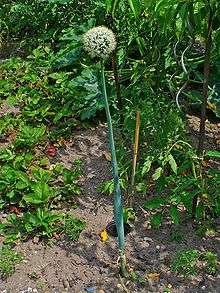
Allium cepa (common onion)
Etymology
Noun
allium (plural alliums)
See also
-

-

-

Latin
Alternative forms
Etymology
From Proto-Indo-European *h₂eHlu- (“esculent root”), uncertainly reconstructed. Related only to Sanskrit आलु (ālu, “esculent root”)[1], whence Hindi आलु (ālu, “potato, yam”), and the culinary borrowing, English aloo (“potato”).
Alternatively, Kroonen suggests that it may be a borrowing from the root of Ancient Greek ἄγλις (áglis), specifically via a byform *adlī-. See the Ancient Greek entry for more.[2]
Pronunciation
- (Classical) IPA(key): /ˈal.li.um/, [ˈal.li.ũ]
Noun
allium n (genitive alliī); second declension
Declension
Second declension.
| Case | Singular | Plural |
|---|---|---|
| nominative | allium | allia |
| genitive | alliī allī1 |
alliōrum |
| dative | alliō | alliīs |
| accusative | allium | allia |
| ablative | alliō | alliīs |
| vocative | allium | allia |
1Found in older Latin (until the Augustan Age).
Descendants
See also
- alum (“wild garlic”)
References
- allium in Charlton T. Lewis and Charles Short (1879) A Latin Dictionary, Oxford: Clarendon Press
- allium in Charlton T. Lewis (1891) An Elementary Latin Dictionary, New York: Harper & Brothers
- allium in Gaffiot, Félix (1934) Dictionnaire Illustré Latin-Français, Hachette
- allium in Harry Thurston Peck, editor (1898) Harper's Dictionary of Classical Antiquities, New York: Harper & Brothers
- ↑ Mallory, Encyclopedia of Indo-European Culture
- ↑ Kroonen, Guus (2012), “An Akkadian loanword in Pre-Greek: on the etymology of Greek ἄγλις and γέλγις 'garlic'”, in The Journal of Indo-European Studies, volume 40, page 295
This article is issued from
Wiktionary.
The text is licensed under Creative Commons - Attribution - Sharealike.
Additional terms may apply for the media files.