albero
See also: alberò
English
Etymology
Noun
albero (uncountable)
Anagrams
Italian
Pronunciation
- IPA(key): [ˈalbero]
- Hyphenation: àl‧be‧ro
-
Audio (IT) (file)
Etymology 1
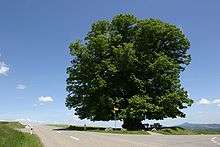
From Latin arbor, arborem[1][2], from Old Latin arbōs, arbōsis, ultimately from Proto-Indo-European *h₃erdʰ- (“high, to grow”). Compare Catalan arbre, French arbre, Occitan arbre, Portuguese árvore, Spanish árbol, Romanian arbore. Doublet of arbore.
Noun
albero m (plural alberi)
Related terms
See also
Etymology 2
Possibly from a Vulgar Latin *albarus, a derivative of Latin albus (“white”).[3][4]
Alternative forms
- albaro (regional)
Noun
albero m (plural alberi)
- poplar tree
Synonyms
Etymology 3
Verb
albero
- first-person singular present indicative of alberare
Anagrams
References
Spanish
FWOTD – 2 November 2013
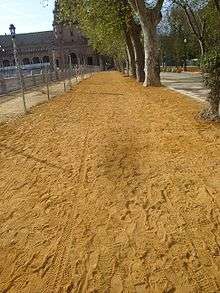
Albero.
Etymology
From Latin albārius (“pertaining to the whitening of walls”).
Pronunciation
- IPA(key): /alˈbeɾo/
- Hyphenation: al‧be‧ro
Noun
albero m (plural alberos)
- a type of crushed rock applied over gardens and bullring arenas
- 2010, Antonio Ramos Espejo, Andaluzas, protagonistas a su pesar, Centro de Estudios Andaluces, page 258:
- Manolete, además, hace un esfuerzo supremo cada vez que pisa el albero de la plaza de Córdoba.
- Furthermore, Manolete undertakes a supreme effort each time he steps on the crushed rock of Cordoba’s bullring.
- Manolete, además, hace un esfuerzo supremo cada vez que pisa el albero de la plaza de Córdoba.
- 2010, Antonio Ramos Espejo, Andaluzas, protagonistas a su pesar, Centro de Estudios Andaluces, page 258:
- (bullfighting) an arena
This article is issued from
Wiktionary.
The text is licensed under Creative Commons - Attribution - Sharealike.
Additional terms may apply for the media files.