Spiegel
See also: spiegel
English
Etymology
Proper noun
Spiegel
- A surname.
German
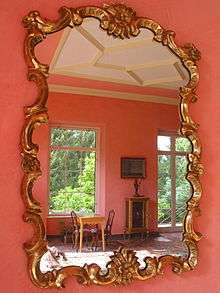
Spiegel (sense 1)
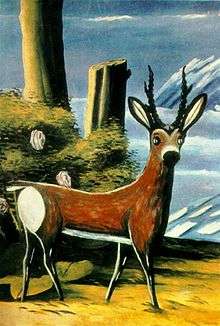
Spiegel of a deer (sense 4.3)
Etymology
From Middle High German spiegel, from Old High German spiegal or spēgal, from Medieval Latin speglum, from Latin speculum. Cognate with Dutch spiegel.[1]
Pronunciation
- IPA(key): /ˈʃpiːɡ(ə)l/
audio (Germany) (file) audio (Austria) (file)
Noun
Spiegel m (genitive Spiegels, plural Spiegel, diminutive Spiegelchen n or Spieglein n)
- mirror
- 1812, Brüder Grimm, Sneewittchen:
- […] Sie hatte auch einen Spiegel, vor den trat sie alle Morgen und fragte: / „Spieglein, Spieglein an der Wand: / wer ist die schönste Frau in dem ganzen Land?“ […]
- Sie hatte einen großen Spiegel. ― She had a large mirror.
-
- level of a liquid
- Synonyms: Pegel, Konzentration
- Meeresspiegel ― sea level
- schematic overview, table
- Synonym: Tabelle
- Notenspiegel
- (please add an English translation of this usage example)
- Gehaltsspiegel
- (please add an English translation of this usage example)
- (hunting) white or light-coloured mark
- on the forehead of horses and cattle
- Das Pony hatte einen hübsch geformten Spiegel auf der Stirn.
- (please add an English translation of this usage example)
- on the wing of a goose, capercaillie, or black cock
- on the hind quarters of deer
- on the forehead of horses and cattle
Declension
Derived terms
- spiegelverkehrt
- Autospiegel
- Blutspiegel (“blood level”)
- Cholesterinspiegel (“blood cholesterol level”)
- Meeresspiegel
- Plasmaspiegel
- Spiegelbild
- Wasserspiegel (“water level”)
Related terms
References
- ↑ Kluge, Friedrich (1989), “Spiegel”, in Elmar Seebold, editor, Etymologisches Wörterbuch der deutschen Sprache [Etymological dictionary of the German language] (in German), 22nd edition, →ISBN
Further reading

- Spiegel in Duden online
This article is issued from
Wiktionary.
The text is licensed under Creative Commons - Attribution - Sharealike.
Additional terms may apply for the media files.