Pegasus
Translingual
Etymology
Latin Pegasus (“mythical white winged stallion of Medusa and Poseidon”)
Proper noun
Pegasus m
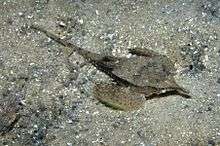
- A taxonomic genus within the family Pegasidae – small fish with pectoral fins and body covered with hard, bony plates, from the East Indies and China.
Hypernyms
- (genus): Vertebrata - subphylum; Gnathostomata - infraphylum; Osteichthyes - superclass; Actinopterygii - class; Neopterygii - subclass; Teleostei - infraclass; Acanthopterygii - superorder; Gasterosteiformes - order; Pegasidae - family
Hyponyms
- (genus): Pegasus lancifer, Pegasus laternarius, Pegasus volitans - species
References
-

-

-

English
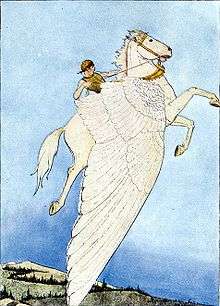
Pegasus and Bellerophon, from Mabie, Hamilton Wright (Ed.):Myths Every Child Should Know (1914) (1)
Etymology
From Latin, from Ancient Greek Πήγασος (Pḗgasos), traditionally associated with πηγή (pēgḗ, “spring, fountain, fountain fed by a spring”), especially used to denote springs of Ocean, where Perseus killed Medusa, from whose blood Pegasus sprang. Some have dismissed this as folk etymology and suggest a pre-Greek origin because of the -ασος suffix.
Proper noun
Pegasus
- (Greek mythology) A winged horse fabled to have sprung from the blood of Medusa when she was slain. He is noted for causing, with a blow of his hoof, Hippocrene, the inspiring fountain of the Muses, to spring from Mount Helicon. Bellerophon tamed and rode upon Pegasus when he defeated the Chimaera.
- (astronomy) An autumn constellation of the northern sky, near the vernal equinoctial point, said to resemble the mythical horse. Its three brightest stars, with the brightest star of Andromeda, form the square of Pegasus. It contains the stars Markab and Algenib.
Translations
mythical winged horse
|
constellation
Noun
Pegasus (plural Pegasi)
See also
Dutch
Proper noun
Pegasus m
Finnish
Proper noun
Pegasus
Declension
| Inflection of Pegasus (Kotus type 39/vastaus, no gradation) | |||
|---|---|---|---|
| nominative | Pegasus | — | |
| genitive | Pegasuksen | — | |
| partitive | Pegasusta | — | |
| illative | Pegasukseen | — | |
| singular | plural | ||
| nominative | Pegasus | — | |
| accusative | nom. | Pegasus | — |
| gen. | Pegasuksen | ||
| genitive | Pegasuksen | — | |
| partitive | Pegasusta | — | |
| inessive | Pegasuksessa | — | |
| elative | Pegasuksesta | — | |
| illative | Pegasukseen | — | |
| adessive | Pegasuksella | — | |
| ablative | Pegasukselta | — | |
| allative | Pegasukselle | — | |
| essive | Pegasuksena | — | |
| translative | Pegasukseksi | — | |
| instructive | — | — | |
| abessive | Pegasuksetta | — | |
| comitative | — | — | |
See also
- Pegasos
Latin
Etymology
From Ancient Greek Πήγασος (Pḗgasos).
Pronunciation
- (Classical) IPA(key): /ˈpeː.ɡa.sus/, [ˈpeː.ɡa.sʊs]
Proper noun
Pēgasus m (genitive Pēgasī); second declension
- (Greek mythology) Pegasus
- A Roman cognomen — famously held by:
- Lucius Plotius Pegasus, a Roman senator
Declension
Second declension.
| Case | Singular |
|---|---|
| nominative | Pēgasus |
| genitive | Pēgasī |
| dative | Pēgasō |
| accusative | Pēgasum |
| ablative | Pēgasō |
| vocative | Pēgase |
Derived terms
- Pēgasēius
- Pēgasiānus
References
- Pegasus in Charlton T. Lewis and Charles Short (1879) A Latin Dictionary, Oxford: Clarendon Press
- Pegasus in Gaffiot, Félix (1934) Dictionnaire Illustré Latin-Français, Hachette
This article is issued from
Wiktionary.
The text is licensed under Creative Commons - Attribution - Sharealike.
Additional terms may apply for the media files.