Iesus
See also: iesus
English
Proper noun
Iesus
- Archaic spelling of Jesus.
- 1660, Doctour Cranmer, Arch-Bishop of Canterbury, Dr. Goodrick, Bishop of Ely, Dr. Skip, Bishop of Hereford, Dr. Thirlby, Bishop of Westminster, Dr. Day, Bishop of Chichester, Dr. Holbeck, Bishop of Lincoln, Dr. Ridley, Bishop of Rochester, Dr. May, Dean of St. Paul's, Dr. Taylor, Dean of Lincoln, Dr. Heyns, Dean of Exeter, Dr. Redman, Dean of Westminster, Dr. Cos, Almoner to King Edward the Sixth, & Mr. Robinson, Arch-Deacon of Leicester, The Book of Common Prayer, and Administration of the Sacraments, and Other Rites and Ceremonies of the Church of England:
- And forthwith he came to Iesus and said, Hail master, and kissed him. And Iesus said unto him , Friend , wherefore art thou come?
- 1670, The True Portraiture of the Church of Iesus-Christ:
- In no wise: For Iesus Christ remains alwayes first and supreme Pastor, and S. Peter and his Successors are only his Lievtenants and Vicars upon earth; and in this manner that doth rather raise Iesus Chrifts authority, than lessen it ; for even as it is an honor to a King to have under him Governors of Provinces, vice-Royes, Lievrenants and Generalls of Armies, to whom his Subjects pay obedience, because of the power given them by the King : so likewise it is an honor to Iesus Christ to have in the Kingdom of his Church Vicars and Lievtenents that my visibly govern his Church, and whom he hath commanded us to obey as his own self.
- 1684, Thomas Sternhold & John Hopkins, The Whole Book of Psalms: Collected Into English Metre, page 2:
- Paul a prisoner of Iesus Christ, and Timothy our brother unto Philemon our dearly beloved, and fellow-labourer.
-
Anagrams
Latin
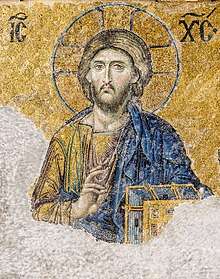
Ιmāgō Iēsū in Sancta Sophia ― An image of Jesus in Hagia Sophia
Alternative forms
Etymology
From Ancient Greek Ἰησοῦς (Iēsoûs), from Hebrew יֵשׁוּעַ (Yeshúa').
Pronunciation
- (Classical) IPA(key): /ˈjeː.sus/, [ˈjeː.sʊs]
- (Ecclesiastical) IPA(key): /ˈje.sus/, [ˈjeː.sus]
-
Audio (Classical) (file)
Proper noun
Iēsus m (variously declined, genitive Iēsū); fourth declension, irregular declension
Declension
Highly irregular, but often considered to belong to the fourth declension.
| Case | Singular |
|---|---|
| nominative | Iēsus |
| genitive | Iēsū |
| dative | Iēsū |
| accusative | Iēsum |
| ablative | Iēsū |
| vocative | Iēsū |
Descendants
References
- Iesus in Charlton T. Lewis and Charles Short (1879) A Latin Dictionary, Oxford: Clarendon Press
- Iesus in Gaffiot, Félix (1934) Dictionnaire Illustré Latin-Français, Hachette
Middle French
Proper noun
Iesus
See also
This article is issued from
Wiktionary.
The text is licensed under Creative Commons - Attribution - Sharealike.
Additional terms may apply for the media files.