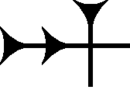
𒀭
 | ||||||||
Translingual
Symbol
𒀭
- Cuneiform sign AN.
𒀭
Cuneiform sign AN
- Borger (2003): 10
- Borger (1981): 13
- HZL: 8
- Unicode: U+1202D 𒀭
- phonetic values
- Sumerian: AN, DINGIR
- Akkadian: ìl
- Hittite: an
- meanings
- AN "heaven"
- DINGIR "deity"
- AN.BAR "iron"
- NANNA=AN.NA "tin"
- KUR AN.TA "upland"
- AN KI "heaven and earth"
- AN GE6 "eclipse (of a celestial body)"
- evolution
- originally a drawing of a star; in Sumerian cuneiform consisting of four crossing wedges,


References
- R. Borger, Assyrisch-Babylonische Zeichenliste, 2nd ed., Neukirchen-Vluyn (1981)
- R. Borger, Mesopotamisches Zeichenlexikon, Münster (2003).
- Chr. Rüster, E. Neu, Hethitisches Zeichenlexikon (HZL), Wiesbaden (1989)
Akkadian
Etymology 1
From Proto-Semitic *ʾil- (“deity”).
Noun
𒀭 (ilu‹m›) m
[DINGIR]
Noun
𒀭 (ilatu‹m›) f
[DINGIR]
- (logogram) goddess
Noun
𒀭 (d)
[DINGIR]
Etymology 2
From Proto-Semitic *šamāy- (“sky, heaven”).
Noun
𒀭 (šamû)
[AN]
- (logographic, plural only) sky (Often spelled 𒀭𒈨𒌍 (AN.MEŠ)
Etymology 3
Proper noun
𒀭 (anu‹m›)
References
Sumerian
Noun
𒀭 (DINGIR)
This article is issued from
Wiktionary.
The text is licensed under Creative Commons - Attribution - Sharealike.
Additional terms may apply for the media files.