鳥居
Chinese
| bird; penis | reside | ||
|---|---|---|---|
| trad. (鳥居) | 鳥 | 居 | |
| simp. (鸟居) | 鸟 | 居 | |
Pronunciation
- Mandarin
- (Standard Chinese)+
- Pinyin:
- Zhuyin: ㄋㄧㄠˇ ㄐㄩ
- Gwoyeu Romatzyh: neaujiu
- IPA (key): /ni̯ɑʊ̯²¹⁴⁻²¹¹ t͡ɕy⁵⁵/
- (Standard Chinese)+
Noun
鳥居
- torii (symbolic gate to a Shinto shrine or Buddhist temple)
Japanese
| Kanji in this term | |
|---|---|
| 鳥 | 居 |
| とり Grade: 2 |
い Grade: 5 |
| kun’yomi | |
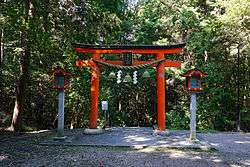
鳥居: A typical red torii, as seen at the Ryōsen-ji Buddhist temple in Nara.
Etymology
Compound of 鳥 (tori, “bird”) + 居 (i, “abode”). From old legends about birds possessed by kami and sitting on tree branches.[1]
Pronunciation
Noun
鳥居 (hiragana とりい, rōmaji torii, historical hiragana とりゐ)
- a torii: a symbolic gate to a Shinto shrine or Buddhist temple
- a similar roofless gate to a residence
- the top bar of a railing
- the top horizontal bar of a balance scale for measuring weight
Synonyms
- (shrine gate): 華表 (kahyō)
Proper noun
鳥居 (hiragana とりい, rōmaji Torii, historical hiragana とりゐ)
- A surname.
References
This article is issued from
Wiktionary.
The text is licensed under Creative Commons - Attribution - Sharealike.
Additional terms may apply for the media files.