鎌
See also: 镰
| ||||||||
Translingual
Han character
鎌 (radical 167, 金+10, 18 strokes, cangjie input 金廿X金 (CTXC), four-corner 88137, composition ⿰釒兼)
References
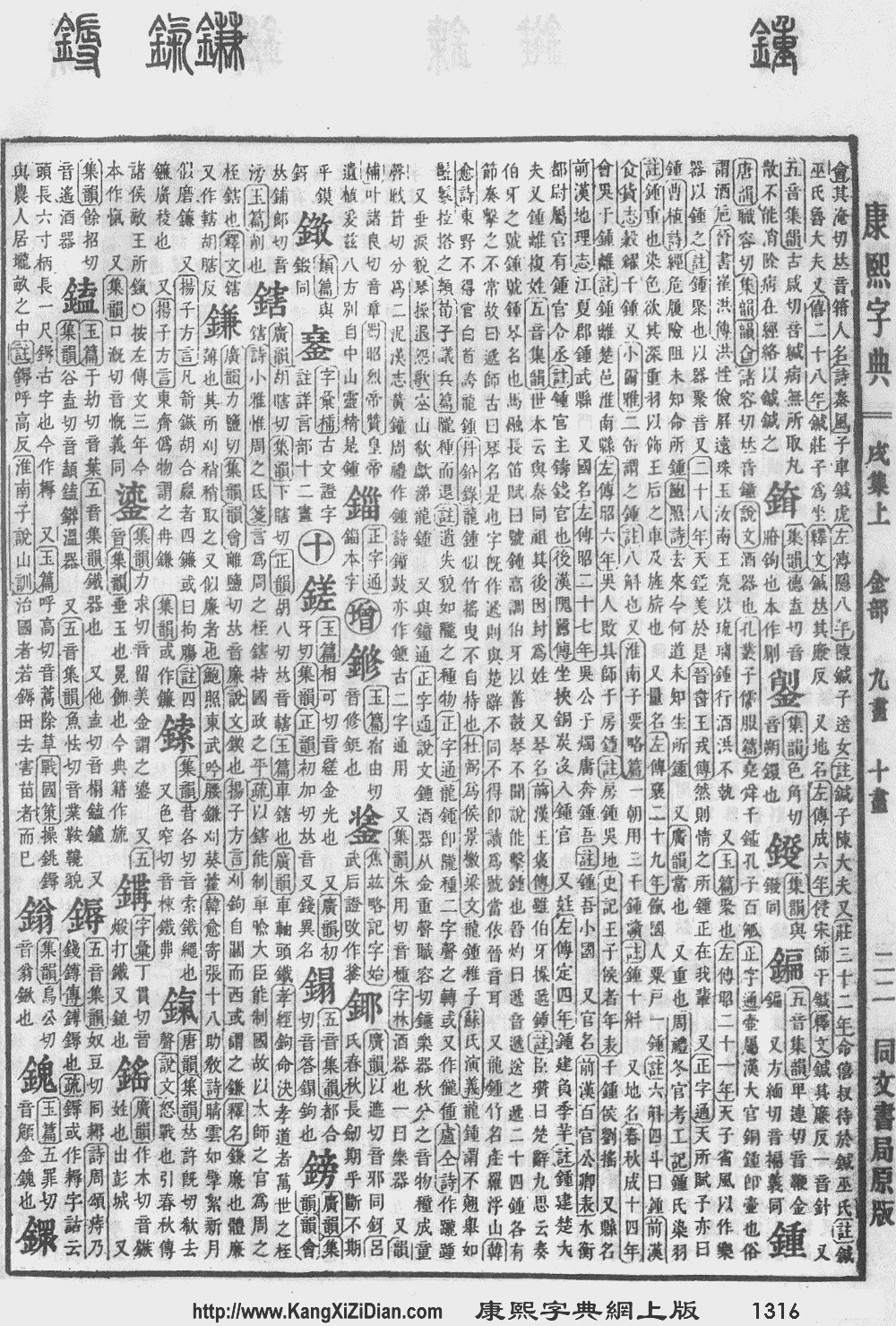
- KangXi: page 1316, character 16
- Dai Kanwa Jiten: character 40693
- Dae Jaweon: page 1816, character 16
- Hanyu Da Zidian: volume 6, page 4244, character 9
- Unihan data for U+938C
Chinese
| For pronunciation and definitions of 鎌 – see 鐮 (“sickle”). (This character, 鎌, is a variant form of 鐮.) |
Japanese
Kanji
鎌
(common “Jōyō” kanji, shinjitai kanji, kyūjitai form 鐮)
Readings
Etymology
| Kanji in this term |
|---|
| 鎌 |
| かま Grade: S |
| kun’yomi |
From Old Japanese. Found in the Man'yōshū, completed some time after 759 CE.
Pronunciation
Noun
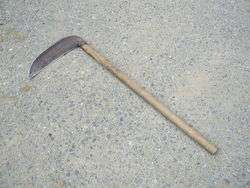
- a sickle
- 1999 February 4, “ダークキラー [Dark Killer]”, in Vol.1 (in Japanese), Konami:
- カマのように発達した腕を振り回し攻撃してくる。
- Kama no yō ni hattatsu shita ude o furimawashi kōgeki shitekuru.
- It attacks with its sickle-like arms.
- カマのように発達した腕を振り回し攻撃してくる。
-
- a sickle-shaped weapon, such as a polearm with a sickle-shaped blade, or a 鎖鎌 (kusarigama)
- short for 火打鎌 (hiuchigama): a striker for lighting fires (from the way that pieces of a broken kama blade were used for this purpose)
- (slang) a perverse or bent tendency or way of thinking (from the way a kama blade bends)
- (slang) a person with a perverse or bent tendency or way of thinking
- a category of 家紋 (kamon, “family crest”) featuring a sickle
- (woodworking) short for 鎌継ぎ (kamatsugi): a hammer-headed tenon (from the way the sickle blade sticks out perpendicular to the handle, similar to the sides of the hammer head on this kind of tenon)
- (slang) excessive talkativeness (probably by sound association with the word 喧しい (yakamashii, “noisy”))
- (slang) an excessively talkative person
- (slang) a penis (probably from the way that a sickle blade sticks out perpendicular to the handle)
Derived terms
Idioms
Idioms
- 鎌が切れる (kama ga kireru): “the sickle cuts well” → to do things with authority, to get things sorted quickly and efficiently, to do things crisply and tidily
- 鎌を掛ける (kama o kakeru): “to apply the sickle” → to get something out of a person without them being aware (compare English to glean); to tempt someone, to draw someone out
- 鎌に掛かる (kama ni kakaru): “to be caught by a sickle” → to be taken in by someone, to be fooled or tricked
References
Korean
Hanja
鎌 • (gyeom) (hangeul 겸, revised gyeom, McCune–Reischauer kyŏm, Yale kyem)
- This term needs a translation to English. Please help out and add a translation, then remove the text
{{rfdef}}.
Vietnamese
Han character
鎌 (gươm)
- This term needs a translation to English. Please help out and add a translation, then remove the text
{{rfdef}}.
This article is issued from
Wiktionary.
The text is licensed under Creative Commons - Attribution - Sharealike.
Additional terms may apply for the media files.