野狐
Japanese
Etymology 1
| Kanji in this term | |
|---|---|
| 野 | 狐 |
| や Grade: 2 |
こ Hyōgaiji |
| on’yomi | |
Appears to be a Japanese coinage from Middle Chinese-derived components.
Pronunciation
Noun
- a wild fox
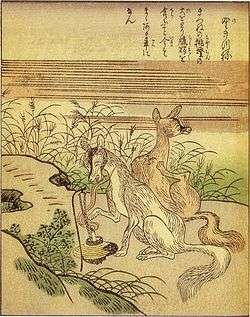
- a mythological spirit fox, fond of tricks and pranks, and capable of possessing people
- (Zen) someone who has not fully attained enlightenment, but puts on airs and becomes self-important as if they have
Derived terms
Derived terms
- 野狐禅 (yakozen): someone who has not fully attained enlightenment, but puts on airs and becomes self-important as if they have
- 野狐憑き (yakotsuki): possession by a spirit fox; someone possessed by a spirit fox; a spirit fox who possesses people
Etymology 2
| Kanji in this term | |
|---|---|
| 野 | 狐 |
| の Grade: 2 |
きつね > ぎつね Hyōgaiji |
| kun’yomi | |
Compound of 野 (no, “field; wilderness”) + 狐 (kitsune, “fox”).[2] The kitsune changes to gitsune as an instance of rendaku (連濁).
Pronunciation
Noun
野狐 (hiragana のぎつね, rōmaji nogitsune)
- a wild fox
- a mythological spirit fox, fond of tricks and pranks, and capable of possessing people
References
This article is issued from
Wiktionary.
The text is licensed under Creative Commons - Attribution - Sharealike.
Additional terms may apply for the media files.