酸漿
See also: 酸浆
Chinese
sour; sore; ache; acid |
starch paste; broth; serum; to starch | ||
|---|---|---|---|
| trad. (酸漿) | 酸 | 漿 | |
| simp. (酸浆) | 酸 | 浆 | |
Pronunciation
- Mandarin
- (Standard Chinese)+
- Pinyin:
- Zhuyin: ㄙㄨㄢ ㄐㄧㄤ
- Gwoyeu Romatzyh: suanjiang
- IPA (key): /su̯a̠n⁵⁵ t͡ɕi̯ɑŋ⁵⁵/
- (Standard Chinese)+
- Cantonese
- (Standard Cantonese, Guangzhou)+
- Jyutping: syun1 zoeng1
- Yale: syūn jēung
- Cantonese Pinyin: syn1 dzoeng1
- Guangdong Romanization: xun1 zêng1
- IPA (key): /ɕyːn⁵⁵ t͡ɕœːŋ⁵⁵/
- (Standard Cantonese, Guangzhou)+
Noun
酸漿
Japanese
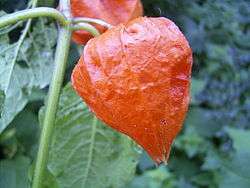
酸漿 (hōzuki): the Chinese lantern plant, showing the fruit in its distinctive husk.
| Kanji in this term | |
|---|---|
| 酸 | 漿 |
| Grade: 5 | Hyōgaiji |
| Irregular | |
Etymology
Probably originally a compound of 頬 (hō, “cheeks”) + 付き (tsuki, “resembling, appearing like”, the 連用形 (ren'yōkei, “continuative or stem form”) of verb 付く tsuku “to stick → to become a certain state or quality”), from the way the husk vaguely resembles bulging red cheeks. The tsuki changes to zuki as an instance of rendaku (連濁).
The 酸漿 kanji spelling is from the Chinese term. The 鬼灯 kanji spelling is an example of jukujikun (熟字訓), literally meaning “demon's lantern”.
Pronunciation
Alternative forms
Noun
酸漿 (hiragana ほおずき, katakana ホオズキ, rōmaji hōzuki, historical hiragana ほほづき, historical katakana ホホヅキ)
- Physalis alkekengi
- Vernacular names include the Chinese lantern, Japanese lantern, bladder cherry, winter cherry, husk tomato, and the strawberry groundcherry.
Usage notes
As with many terms that name organisms, this term is often spelled in katakana, especially in biological contexts, as ホオズキ.
References
- 1988, 国語大辞典(新装版) (Kokugo Dai Jiten, Revised Edition) (in Japanese), Tōkyō: Shogakukan
This article is issued from
Wiktionary.
The text is licensed under Creative Commons - Attribution - Sharealike.
Additional terms may apply for the media files.