脇差
Japanese
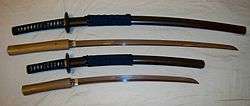
脇差: a wakizashi (with both full koshirae and simpler shirasaya) below a katana (also with koshirae and shirasaya), showing the difference in size.
| Kanji in this term | |
|---|---|
| 脇 | 差 |
| わき Grade: S |
さし > ざし Grade: 4 |
| kun’yomi | |
Etymology
Compound of 脇 (waki, “armpit, side of the torso”) + 差 (sashi, the 連用形 (ren'yōkei, “continuative or stem form”) of verb 差す sasu “to insert, to stick into”), from the way the wakizashi would be stuck at one's side through the 帯 (obi, “belt or sash”).[1] The sashi changes to zashi as an instance of rendaku (連濁).
Pronunciation
Noun
脇差 (hiragana わきざし, rōmaji wakizashi)
- (weaponry) a traditional Japanese shortsword, often used as a secondary weapon to a katana

Coordinate terms
See also
References
This article is issued from
Wiktionary.
The text is licensed under Creative Commons - Attribution - Sharealike.
Additional terms may apply for the media files.