烏帽子鳥
Japanese
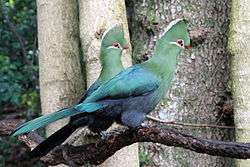
烏帽子鳥 (eboshidori): a pair of Knysna turacos, showing the distinctive head plumage.
| Kanji in this term | |||
|---|---|---|---|
| 烏 | 帽 | 子 | 鳥 |
| え Jinmeiyō |
ぼう > ぼ Grade: S |
し Grade: 1 |
とり > どり Grade: 2 |
| Irregular | |||
Etymology
Compound of 烏帽子 (eboshi, “an ancient style of hat worn by Japanese nobility”) + 鳥 (tori, “bird”), from the way that the bird's head plumage resembles the shape of the eboshi hat. The tori changes to dori as an instance of rendaku (連濁).
Pronunciation
- (Irregular reading)
- IPA(key): [e̞bo̞ɕido̞ɾʲi]
Noun
烏帽子鳥 (hiragana えぼしどり, katakana エボシドリ, rōmaji eboshidori)
- (in general) a turaco (any bird of family Musophagidae)
- (more specifically) a Knysna turaco (Tauraco corythaix)
Usage notes
As with many terms that name organisms, this term is often spelled in katakana, especially in biological contexts, as エボシドリ.
Further reading
-

-
-

This article is issued from
Wiktionary.
The text is licensed under Creative Commons - Attribution - Sharealike.
Additional terms may apply for the media files.