澪標
Japanese
Etymology 1
| Kanji in this term | |
|---|---|
| 澪 | 標 |
| みお Jinmeiyō |
つくし > づくし Grade: 4 |
| Irregular | |
| Kanji in this term | |
|---|---|
| 澪 | 標 |
| みお Jinmeiyō |
つくし Grade: 4 |
| Irregular | |
⟨mi1wo tu kusi⟩ → /miwotukusi/ → /miot͡sukuɕi/
Compound of 澪 (mio, “water channel”) + つ (tsu, Old Japanese possessive particle) + 串 (kushi, “skewer”).[1]
Also encountered with the reading miozukushi. The tsukushi changes to zukushi as an instance of rendaku (連濁).
Notably, different publishers of the same historical texts appear to alternate between the miotsukushi and miojirushi readings, possibly due to historical or dialectal differences.
Pronunciation
Noun
澪標 (hiragana みおつくし, rōmaji miotsukushi, historical hiragana みをつくし)
(alternative reading hiragana みおづくし, romaji miozukushi, historical hiragana みをづくし)
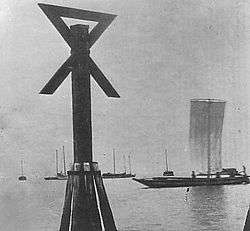
- a dolphin erected as a daybeacon or daymark: a navigational marker indicating the bounds of a water channel
- c. 759, Man'yōshū (book 14, poem 3429), text here
- 等保都安布美伊奈佐保曽江乃水乎都久思安礼乎多能米弖安佐麻之物能乎 [Man'yōgana]
- 遠江引佐細江のみをつくし我を頼めてあさましものを [Modern spelling]
- Tōtsu Ōmi Inasa-hosoe no miotsukushi are o tanomete asamashi mono o
- In Tōtsu Ōmi up Inasa Creek there stand the channel stakes―you could have made me follow and left me high and dry.[3]
- Synonyms: 澪木 (miogi), 澪杭 (miokui), 水尾坊木 (miobōgi)
- c. 759, Man'yōshū (book 14, poem 3429), text here
- (poetry) in waka poetry, a kakekotoba used to pun against the sense of 身を尽くし (mi o tsukushi, literally “exhausting one's body” → “with all one's might, with all one's heart and soul”) [since Heian period]
- c. 950, Gosen Wakashū (book 13, poem 860; also Hyakunin Isshu, poem 20)
Proper noun
澪標 (hiragana みおつくし, rōmaji Miotsukushi, historical hiragana みをつくし)
- the fourteenth chapter of The Tale of Genji
- name of a type of incense
Etymology 2
| Kanji in this term | |
|---|---|
| 澪 | 標 |
| みお Jinmeiyō |
しるし > じるし Grade: 4 |
| kun’yomi | |
⟨mi1wo sirusi⟩ → /miwozirusi/ → /miod͡ʑiruɕi/
Compound of 澪 (mio, “water channel”) + 標 (shirushi, “mark, sign”). The shirushi changes to jirushi as an instance of rendaku (連濁).
Notably, different publishers of the same historical texts appear to alternate between the miojirushi and miotsukushi readings, possibly due to historical or dialectal differences.
Pronunciation
Alternative forms
- 水脈標
Noun
澪標 (hiragana みおじるし, rōmaji miojirushi, historical hiragana みをじるし)
- a dolphin erected as a daybeacon or daymark: a navigational marker indicating the bounds of a water channel
- 12th century, Sanka Wakashū (book 1, poem 217)
- 広瀬川渡りの沖のみをじるし水嵩ぞ深き五月雨の頃
- Hirose-gawa watari no oki no miojirushi mikasa zo fukaki samidare no koro
- (please add an English translation of this example)
- 広瀬川渡りの沖のみをじるし水嵩ぞ深き五月雨の頃
- 12th century, Sanka Wakashū (book 1, poem 217)
Etymology 3
| Kanji in this term | |
|---|---|
| 澪 | 標 |
| れい Jinmeiyō |
ひょう Grade: 4 |
| on’yomi | |
/reiheu/ → /reːhjoː/
From Middle Chinese 澪標 (MC leŋ piᴇu).
Pronunciation
Noun
澪標 (hiragana れいひょう, rōmaji reihyō, historical hiragana れいへう)
References
- ↑ 1995, 大辞泉 (Daijisen) (in Japanese), Tōkyō: Shogakukan, →ISBN
- 1 2 3 4 2006, 大辞林 (Daijirin), Third Edition (in Japanese), Tōkyō: Sanseidō, →ISBN
- ↑ Edwin A. Cranston (1998) The Gem-Glistening Cup, Stanford University Press, →ISBN, page 734
- ↑ Joshua S. Mostow (1996) Pictures of the Heart: The Hyakunin Isshu in Word and Image, illustrated edition, University of Hawaii Press, →ISBN, page 201