桜ん坊
Japanese
| Kanji in this term | |
|---|---|
| 桜 | 坊 |
| さくら Grade: 5 |
ぼう Grade: S |
Alternative forms
- 桜桃 (less common)
Etymology
/sakuranbau/ → /sakuranbɔː/ → /sakuranboː/
Etymology unclear. Leading theories include:
- Compound of 桜 (sakura, “cherry, cherry tree”) + の (no, possessive particle) + 坊 (bō, “boy, monk”, in reference to the tradition of shaven heads, indicating the smooth skin of the cherry fruit)
- Compound of 桜 (sakura, “cherry, cherry tree”) + 桃 (momo, “peach”, in reference to fruit in general; with a phonetic shift from /m/ to /b/ and shift from /bobo/ to /boː/, )
Given the historical reading of sakuranbau, matching the historical bau reading of 坊, the initial derivation seems more likely.
The sakuranbō represents a regular historical shift from older sakuranbau. Sakuranbō with the long ō has been somewhat superseded in modern Japanese by the shortened reading sakuranbo.
The alternative 桜桃 spelling is an example of jukujikun (熟字訓), from Middle Chinese 櫻桃.
Pronunciation
Noun
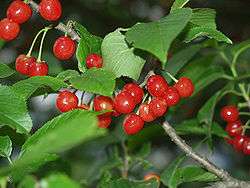
桜ん坊 (hiragana さくらんぼう, rōmaji sakuranbō, alternative reading さくらんぼ, katakana サクランボ, rōmaji sakuranbo, historical hiragana さくらんばう)
- (fruit) cherry (mostly used for Japanese cherries)
- Synonym: チェリー (cherī) (mostly used for non-Japanese cherries)
Related terms
- 桜 (sakura): cherry tree
References
This article is issued from
Wiktionary.
The text is licensed under Creative Commons - Attribution - Sharealike.
Additional terms may apply for the media files.