新興国
Japanese
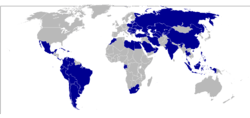
新興国 (shinkō koku): emerging countries around the world.
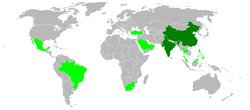
新興国 (shinkō koku): newly industrialized countries.
| Kanji in this term | ||
|---|---|---|
| 新 | 興 | 国 |
| しん Grade: 2 |
こう Grade: 5 |
こく Grade: 2 |
| on’yomi | ||
Etymology
Compound of 新興 (shinkō, “burgeoning, rising”) + 国 (koku, “country”).[1]
Pronunciation
Noun
新興国 (hiragana しんこうこく, rōmaji shinkō koku)
- emerging country, newly industrialized country
- (dated) a newly independent country, no longer a colony
Usage notes
A country labeled as a 新興国 in Japanese could be deemed in English to be either an emerging country or a newly industrialized country, or even both, depending on the context.
The sense of no longer a colony is no longer used in modern contexts.
Related terms
- 先進国 (senshin koku): developed country
- 発展途上国 (hatten tojō koku): developing country
- 開発途上国 (kaihatsu tojō koku): developing country (less common synonym of 発展途上国)
- 低開発国 (tei kaihatsu koku): developing country (literally, “low-development country”)
- 後進国 (kōshin koku): developing country (less common; literally, “backward country”)
References
This article is issued from
Wiktionary.
The text is licensed under Creative Commons - Attribution - Sharealike.
Additional terms may apply for the media files.