後妻打ち
Japanese
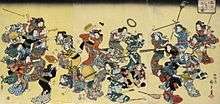
往古うハなり打ちの図 (Ōko Uwanari-uchi no Zu) by Utagawa Hiroshige (1852): a group of wives and concubines striking each other
| Kanji in this term | ||
|---|---|---|
| 後 | 妻 | 打 |
| Grade: 2 | Grade: 5 | う(ち) Grade: 3 |
| Irregular | ||
Etymology
Compound of 後妻 (uwanari, “later wife, concubine”) + 打ち (uchi, “striking, hitting”).
Noun
後妻打ち (hiragana うわなりうち, rōmaji uwanari-uchi, historical hiragana うはなりうち)
- (historical) an ancient Japanese custom of a first wife to attack any of her husband's later wives and/or concubines, usually for revenge or to protect her own interests [late Heian- to around the Sengoku period]
- (historical) an arranged striking between wives and concubines held at a (legal) wife's house [around the Muromachi to mid-Edo period]
- Synonyms: 相当打ち (sōtō-uchi), 騒動打ち (sōdō-uchi)
See also
References
- 1984, 日本大百科全書:ニッポニカ (Nippon Dai Hyakka Zensho: Nipponica, “Encyclopedia Nipponica”) (in Japanese), Tōkyō: Shogakukan, relevant text online here.
- 1995, 大辞泉 (Daijisen) (in Japanese), Tōkyō: Shogakukan, →ISBN
- 2006, 大辞林 (Daijirin), Third Edition (in Japanese), Tōkyō: Sanseidō, →ISBN
- 2014, ブリタニカ国際大百科事典 小項目事典 (Buritanika Kokusai Dai Hyakka Jiten: Shō Kōmoku Jiten, “Encyclopædia Britannica International: Micropædia”) (in Japanese), Tōkyō: Britannica Japan Co., Ltd., relevant text online here.
- Chieko Irie Mulhern (2015) Heroic with Grace: Legendary Women of Japan: Legendary Women of Japan, Routledge, →ISBN, pages x, 175-178
This article is issued from
Wiktionary.
The text is licensed under Creative Commons - Attribution - Sharealike.
Additional terms may apply for the media files.