こどもの日
Japanese
| Kanji in this term |
|---|
| 日 |
| Grade: 1 |
Etymology
Compound of こども (kodomo, “child, children”) + の (no, “possessive particle”) + 日 (hi, “day”).
Pronunciation
Proper noun
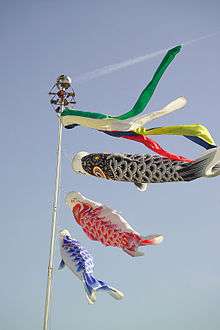
Koinobori: carp (koi) streamers put up for Children's Day. The black carp (Magoi) at the top represents the father, the red carp (Higoi) represents the mother, and the last carp represents the son, with an additional carp added for each subsequent son with color and position denoting their relative age.
こどもの日 (hiragana こどものひ, rōmaji Kodomo no Hi)
- Children's Day, a festival held in Japan on 5 May to celebrate children; part of the Golden Week series of holidays in May
Alternative forms
- 子供の日
See also

- List of festivals in Japan on Wiktionary
- List of festivals in Japan on Wikipedia
This article is issued from
Wiktionary.
The text is licensed under Creative Commons - Attribution - Sharealike.
Additional terms may apply for the media files.