มหาราช
Thai
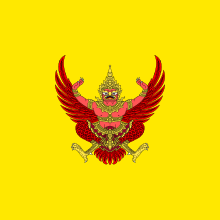
the standard of the monarch of Thailand
Alternative forms
Alternative forms
- มหาราชา
- มหาราชาธิราช
Etymology
From มหา (má-hǎa, “grand; grand; etc”) + ราช (râat, “monarch, sovereign; chief, head, leader”); ultimately from Sanskrit महाराज (mahārāja, “emperor; great king; supreme sovereign”), from मह (maha, “grand; great”) + राज (rāja, “king; sovereign”), probably via Old Khmer mahārāja (“great king; great prince; supreme monarch”). Compare Modern Khmer មហារាជ (mɔɔhaariəc).
The third sense was probably first used during the reign of King Mongkut (1851–1868) or Chulalongkorn (1868–1910).[1]
Pronunciation
| Orthographic | มหาราช m h ā r ā d͡ʑ | |
| Phonemic | มะ-หา-ราด m a – h ā – r ā ɗ | |
| Romanization | Paiboon | má-hǎa-râat |
| Royal Institute | ma-ha-rat | |
| (standard) IPA(key) | /ma˦˥.haː˩˩˦.raːt̚˥˩/ | |
Noun
มหาราช • (má-hǎa-râat)
- emperor; king of kings; maharaja.
- (historical) king of Lan Na.
- the Great: a title given to an important male monarch.
- อเล็กซานเดอร์มหาราช
- à-lék-saan-də̂ə má-hǎa-râat
- Alexander the Great
-
- the standard of the monarch of Thailand, being a yellow flag with the mythological bird garuda.
Antonyms
Antonyms
- มหาเทวี
- มหาราชินี
Derived terms
Derived terms
- ธงมหาราช
- มหาราชลีลา
References
- ↑ สุทธิพันธ์ ขุรานนท์. (๒๕๕๐). "พระนามพระมหากษัตริย์ไทยที่ทรงเป็นมหาราช". ใน ปกิณกคดีประวัติศาสตร์ไทย. กรุงเทพฯ: กรมศิลปากร. →ISBN. หน้า ๑๐๘.
This article is issued from
Wiktionary.
The text is licensed under Creative Commons - Attribution - Sharealike.
Additional terms may apply for the media files.