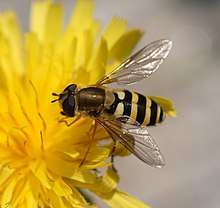
Diptera
Taxonavigation
Superregnum: Eukaryota
Regnum: Animalia
Subregnum: Eumetazoa
Cladus: Bilateria
Cladus: Nephrozoa
Cladus: Protostomia
Cladus: Ecdysozoa
Cladus: Panarthropoda
Phylum: Arthropoda
Subphylum: Hexapoda
Classis: Insecta
Cladus: Dicondylia
Subclassis: Pterygota
Cladus: Metapterygota
Infraclassis: Neoptera
Cladus: Eumetabola
Cladus: Endopterygota
Superordo: Panorpida
Cladus: Antliophora
Ordo: Diptera
Subordines (2):
Brachycera -
Nematocera [paraphyletic]
Familia incertae sedis: †Hennigmatidae - †Limnorhyphidae
References
selected references
- Lambkin, C.L. et al. 2013: The phylogenetic relationships among infraorders and superfamilies of Diptera based on morphological evidence. Systematic entomology, 38(1): 164–179. DOI: 10.1111/j.1365-3113.2012.00652.x
- Pape, T., Blagoderov, V. & Mostovski, M.B. 2011. Order Diptera Linnaeus, 1758. Pp 222–229 In Zhang, Z.-Q. (ed.) 2011. Animal biodiversity: an outline of higher-level classification and survey of taxonomic richness. Zootaxa 3148: 1–237. Open access. Reference page. . (PDF) Reference page.
Additional references
- Amorim, D.S.; Yeates, D. 2006: Pesky gnats: ridding dipteran classification of the Nematocera. Studia dipterologica, 13: 3–9.
- Bertone, M.A.; Courtney, G.W.; Wiegmann, B.M. 2008: Phylogenetics and temporal diversification of the earliest true flies (Insecta: Diptera) based on multiple nuclear genes. Systematic entomology, 33: 668–687. DOI: 10.1111/j.1365-3113.2008.00437.x
- Bickel, D. 2009: Biogeography of Diptera in the southwest Pacific. pp. 257–275 in: Pape, T.; Bickel, D.; Meier, R. (eds.) 2009: Diptera diversity: status, challenges and tools. Koninklijke Brill NV.
- Bickel, D. 2009: Why Hilara is not amusing: the problem of open-ended taxa and the limits of taxonomic knowledge. pp. 279–301 in: Pape, T.; Bickel, D.; Meier, R. (eds.) 2009: Diptera diversity: status, challenges and tools. Koninklijke Brill NV.
- Borkent, A. 2018. The State of Phylogenetic Analysis: Narrow Visions and Simple Answers —Examples from the Diptera (flies). Zootaxa 4374(1): 107–143. DOI: 10.11646/zootaxa.4374.1.7 Full article (PDF) Reference page.
- Borkent, A. & Brown, B.V. 2015: How to inventory tropical flies (Diptera)—One of the megadiverse orders of insects. Zootaxa 3949(3): 301–322. DOI: 10.11646/zootaxa.3949.3.1 . Preview (PDF) Full article (PDF) Reference page.
- Borkent, A., Brown, B.V., Adler, P.H., Amorim, D. de S., Barber, K.N., Bickel, D.J., Boucher, S., Brooks, S.E., Burger, J., Burington, Z.L., Capellari, R.S., Costa, D.N.R., Cumming, J.M., Curler, G., Dick, C.W., Epler, J.H., Fisher, E., Gaimari, S.D., Gelhaus, J., Grimaldi, D.A., Hash, J., Hauser, M., Hippa, H., Ibáñez-Bernal, S., Jaschhof, M., Kameneva, E.P., Kerr, P.H., Korneyev, V., Korytkowski, C.A., Kung, G-A., Kvifte, G.M., Lonsdale, O., Marshal, S.A., Mathis, W.N., Michelsen, V., Naglis, S., Norrbom, A.L., Paiero, S.M., Pape, T., Pereira-Colavite, A., Pollet, M., Rochefort, S., Rung, A., Runyon, J., Savage, J., Silva, V.C., Sinclair, B.J., Skevington, J.H., Stireman, J.O. III, Swann, J., Vilkamaa, P., Wheeler, T., Whitworth, T.L., Wong, M.A., Wood, D.M., Woodley, N.E., Yau, T., Zavortnik, T.J. & Zumbado, M.A. 2018. Remarkable fly (Diptera) diversity in a patch of Costa Rican cloud forest: Why inventory is a vital science. Zootaxa 4402(1): 53–90. DOI: 10.11646/zootaxa.4402.1.3 . Full article (PDF) Reference page.
- Chaladze, G. 2017. Taxonomy should be more photography based–eliminate need of physical specimen to study morphology. Zootaxa 4247(3): 331–331. DOI: 10.11646/zootaxa.4247.3.6 . Reference page.
- Convey, P.; Block, W. 1996: Antarctic Diptera: ecology, physiology and distribution. European journal of entomology, 93: 1–13.
- Courtney, G.W. et al. 2009: Biodiversity of Diptera. pp. 185–222 in: Foottit, R.G.; Adler, P.H. (eds.) 2009: Insect biodiversity: science and society. Blackwell Publishing Ltd. ISBN 9781405151429
- Erwin, T. 2013: FLIES – The Natural History and Diversity of Diptera. ZooKeys, 261: 85–86. DOI: 10.3897/zookeys.261.4628 Reference page.
- Evenhuis, N.L. 2010: Type designations of Diptera (Insecta) in the Encyclopaedia Metropolitana. Zootaxa, 2653: 37–50. Preview
- Evenhuis, N.L. & Pape, T. 2017. Battling the un-dead: the status of the Diptera genus-group names originally proposed in Johann Wilhelm Meigen’s 1800 pamphlet. Zootaxa 4275(1): 1–74. DOI: 10.11646/zootaxa.4275.1.1 . Reference page.
- Evenhuis, N.L., Pape, T. & Pont, A.C. 2016. Nomenclatural Studies Toward a World List of Diptera Genus-Group Names. Part V: Pierre-Justin-Marie Macquart. Zootaxa 4172(1): 1–211. DOI: 10.11646/zootaxa.4172.1.1 . Full article (PDF) ISBN 978-1-77557-528-3 (paperback); ISBN 978-1-77557-529-0 (Online edition) Reference page.
- Evenhuis, N.L., O'Hara, J.E., Pape, T. & Pont, A.C. 2010. Nomenclatural studies toward a world list of Diptera genus-group Names. Part I: André-Jean-Baptiste Robineau-Desvoidy. Zootaxa 2373: 1–265. Preview PDF Reference page.
- Evenhuis, N.L.; Pape, T.; Pont, A.C. 2008: The problems of subsequent typification in genus-group names and use of the Zoological Record: a study of selected post-1930 Diptera genus-group names without type species designations. Zootaxa, 1912: 1–44. Abstract & excerpt PDF
- Friedemann, K.; Schneeberg, K.; Beutel, R.G. 2014: Fly on the wall – attachment structures in lower Diptera. Systematic entomology, 39(3): 460–473. DOI: 10.1111/syen.12064 Reference page.
- el-Hawagry, M.S., Abdel-Dayem, M.S., Elgharbawy, A.A. & al-Dhafer, H.M. 2016. A preliminary account of the fly fauna in Jabal Shada al-A’la Nature Reserve, Saudi Arabia, with new records and biogeographical remarks (Diptera, Insecta). ZooKeys 636: 107-139. DOI: 10.3897/zookeys.636.9905 . Reference page.
- Krzemiński, W.; Krzemińska, E. 2003. Triassic Diptera: descriptions, revisions and phylogenetic relations. Acta zoologica cracoviensia, 46(suppl.– Fossil Insects): 153–184. PDF
- Lukashevich, E.D. et al. 2010: The oldest occurrence of immature Diptera (Insecta), Middle Triassic, France. Annales de la Société entomologique de France (n.s.), 46: 4–22. ISSN: 0037-9271 [not seen]
- Pape, T.; Bickel, D.; Meier, R. (eds.) 2009: Diptera diversity: status, challenges and tools. Koninklijke Brill NV. ISBN 90 04 14897 3
- Sabrosky, W.C. 1999: Family-group names in Diptera and bibliography. Myia, 10 PDF
- Savage, J., Borkent, A., Brodo, F., Cumming, J.M., Curler, G., Currie, D.C., deWaard, J.R., Gibson, J.F., Hauser, M., Laplante,L., Lonsdale, O., Marshall, S.A., O'Hara, J.E., Sinclair, B.J. & Skevington, J.H. 2019. Diptera of Canada. Pp 397–450. DOI: 10.3897/zookeys.819.27625 Reference page.
- Stary, J. 2008: The wing stalk in Diptera, with some notes on the higher-level phylogeny of the order. European journal of entomology, 105: 27–33.
- Wagner, R. et al. 2008: Global diversity of dipteran families (Insecta Diptera) in freshwater (excluding Simulidae, Culicidae, Chironomidae, Tipulidae and Tabanidae). Hydrobiologia, 595: 489–519. DOI: 10.1007/s10750-007-9127-9
- Wolff, M.I., Nihei, S.S. & Carvalho, C.J.B. de (eds.), 2016. Catalogue of Diptera of Colombia. Zootaxa 4122(1): 1–949. DOI: 10.11646/zootaxa.4122.1.1 Title Page (PDF). ISBN 978-1-77557-961-8 (paperback); ISBN 978-1-77557-962-5 (Online edition). Reference page.
- Wolff, M., Nihei, S.S. & Carvalho, C.J.B. de 2016. Catalogue of Diptera of Colombia: an introduction. Zootaxa 4122(1): 8–14. DOI: 10.11646/zootaxa.4122.1.3 . Full article (PDF) Reference page.
- Yeates, D.K.; Bickel, D.; McAlpine, D.K.; Colless, D.H. 2009: Diversity, relationships and biogeography of Australian flies. pp. 227–256 in: Pape, T.; Bickel, D.; Meier, R. (eds.) 2009: Diptera diversity: status, challenges and tools. Koninklijke Brill NV.
- Yeates, D.K.; Wiegmann, B.M.; Courtney, G.W.; Meier, R.; Pape, T. 2007: Phylogeny and systematics of Diptera: two decades of progress and prospects. pp. 565–590 In: Zhang, Z.-Q. & Shear, W.A. (eds) Linnaeus tercentenary: progress in invertebrate taxonomy. Zootaxa, 1668: 1–766. PDF
Links
Vernacular names
Alemannisch: Zweefligler
беларуская: Двухкрылыя
български: Двукрили
čeština: Dvoukřídlí
dansk: Tovinger
Deutsch: Zweiflügler
Ελληνικά: Μύγες
English: two winged flies, true flies, flies
Esperanto: Dipteroj
español: Dípteros
eesti: Kahetiivalised
فارسی: دوبالان
suomi: Kaksisiipiset
Nordfriisk: Twiijügeten
français: Diptère
עברית: זבובאים
magyar: Kétszárnyúak
日本語: ハエ目 (双翅目)
한국어: 파리목
lietuvių: Dvisparniai
македонски: Двокрилци
Nederlands: Tweevleugeligen
norsk: Tovinger
Diné bizaad: Tsʼíʼii / Tséʼédǫ́ʼii
polski: Muchówki
português: Dípteros
русский: Двукрылые
slovenčina: dvojkrídlovce
српски / srpski: Двокрилци
svenska: Tvåvingade
தமிழ்: இருசிறகிப் பூச்சிகள்
Türkçe: Çift kanatlılar
українська: Двокрилі
中文: 雙翅目
беларуская: Двухкрылыя
български: Двукрили
čeština: Dvoukřídlí
dansk: Tovinger
Deutsch: Zweiflügler
Ελληνικά: Μύγες
English: two winged flies, true flies, flies
Esperanto: Dipteroj
español: Dípteros
eesti: Kahetiivalised
فارسی: دوبالان
suomi: Kaksisiipiset
Nordfriisk: Twiijügeten
français: Diptère
עברית: זבובאים
magyar: Kétszárnyúak
日本語: ハエ目 (双翅目)
한국어: 파리목
lietuvių: Dvisparniai
македонски: Двокрилци
Nederlands: Tweevleugeligen
norsk: Tovinger
Diné bizaad: Tsʼíʼii / Tséʼédǫ́ʼii
polski: Muchówki
português: Dípteros
русский: Двукрылые
slovenčina: dvojkrídlovce
српски / srpski: Двокрилци
svenska: Tvåvingade
தமிழ்: இருசிறகிப் பூச்சிகள்
Türkçe: Çift kanatlılar
українська: Двокрилі
中文: 雙翅目
 |
For more multimedia, look at Diptera on Wikimedia Commons. |
This article is issued from
Wikimedia.
The text is licensed under Creative
Commons - Attribution - Sharealike.
Additional terms may apply for the media files.