zirgs
Latvian
Etymology
There are diverging opinions on the origin of this word. The one most likely to be true connects zirgs to the adjective žirgts (“brisk, lively, alert”) (q.v.) from the (no longer in usage) verb žirgt (“to liven up, to freshen up”). The original meaning would therefore have been “brisk, agile (animal),” from which “fast runner” and then “horse” (probably via “stallion,” a meaning still attested dialectally for the Lithuanian cognate). Others links zirgs to Latin grex (“herd, flock”), or to Lithuanian žir̃gti, žer̃gti (“to sit astraddle, to sit; to spread one's legs; to walk with one's legs raised high”), or perhaps to Lithuanian žer̃ti (“to scrape, to scratch; (of horse) to paw”), Armenian ձար (jar, “mane”), or to Old Norse građr (“not castrated”). Cognates include Lithuanian žìrgas (“good, beautiful horse; steed”), Old Prussian sirgis ([zirgis], “stallion”), Sudovian zirgo (“horse”).[1]
Pronunciation
- IPA(key): [zîɾks]
Noun
zirgs m (1st declension)
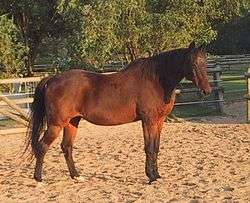
- horse (esp. Equus caballus; generic word)
- šķirnes zirgs ― breed horse
- darba zirgs ― work horse
- sacīkšu zirgs ― race horse
- neiebraukts zirgs ― a horse that has not been run in
- braukt ar zirgu ― to ride (on) a horse
- zirgs rikšo, auļo ― the horse trots, gallops
- zirgs zviedz ― the horse neighs
- apkalt zirgu ― to shoe a horse
- dzirdīt zirgus pie akas ― to make the horses drink at the well
- jūgt zirgu arklā ― to harness a horse to a plow
- strādā kā zirgs ― (s/he) works like a horse
-
Declension
Derived terms
See also
References
- ↑ Karulis, Konstantīns (1992), “zirgs”, in Latviešu Etimoloģijas Vārdnīca (in Latvian), Rīga: AVOTS, →ISBN