warrant
English
Pronunciation
- (Received Pronunciation) IPA(key): /ˈwɒɹənt/
- (General American) IPA(key): /ˈwɔɹənt/
Audio (GA) (file) - (NYC) IPA(key): /ˈwɑɹənt/
- Hyphenation: war‧rant
Etymology 1
From Middle English warant (“protector; guard, shield, protection”), from Anglo-Norman warrant, Old Northern French warant, warand, a variant of Old French guarant, garant, garand (“assurance, guarantee; authorization, permission; protector; protection, safety”) (modern French garant),[1] from Frankish *warand, present participle of *warjan (“to fend off; to stop, thwart”). The word is cognate with Old High German werento (“guarantor”).
Noun
warrant (plural warrants)
- (obsolete) A defender, a protector.
- 1485 July 31, Thomas Malory, “Capitulum secūdum”, in [Le Morte Darthur], book X, [London: William Caxton], OCLC 71490786, leaves 207, verso – 208, recto; republished as H[einrich] Oskar Sommer, editor, Le Morte Darthur, London: Published by David Nutt, in the Strand, 1889, OCLC 890162034, page 415:
- And whanne I ſawe her makynge ſuche dole / I asked her who ſlewe her lorde ¶ Syre ſhe ſaid the falſest knyght of the world now lyuyng and he is the mooſt vylayne that euer man herd ſpeke of / and his name is ſir Breuſe ſaunce pyte / thenne for pyte I made the damoyſel to lepe on her palfroy / and I promyſed her to be her waraunt / and to helpe her to entyere her lord
-
- Authorization or certification; a sanction, as given by a superior.
- Something that provides assurance or confirmation; a guarantee or proof.
- a warrant of authenticity; a warrant for success
- An order that serves as authorization; especially a voucher authorizing payment or receipt of money.
- (finance) An option, usually issued together with another security and with a term at issue greater than a year, to buy other securities of the issuer.
- (law) A judicial writ authorizing an officer to make a search, seizure, or arrest, or to execute a judgment.
- an arrest warrant issued by the court
- (military) Short for warrant officer.
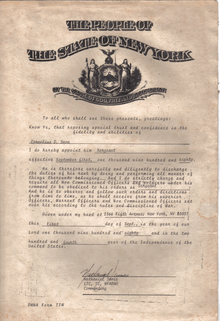
- A certificate of appointment given to a warrant officer.
- (New Zealand, road transport) A document certifying that a motor vehicle meets certain standards of mechanical soundness and safety; a warrant of fitness.
Alternative forms
- warraunt (obsolete)
Derived terms
Related terms
Translations
|
|
|
|
- The translations below need to be checked and inserted above into the appropriate translation tables, removing any numbers. Numbers do not necessarily match those in definitions. See instructions at Wiktionary:Entry layout#Translations.
|
Etymology 2
From Middle English warrant, waranten (“to give protection; to protect, shield; to assure, pledge, promise; to guarantee”), from Anglo-Norman warantir, warandir, warentir, and Old Northern French warandir, warantir, variant forms of Old French guarantir (“to protect”) (modern French garantir),[2] a Romance formation from the noun: see etymology 1 above.
Verb
warrant (third-person singular simple present warrants, present participle warranting, simple past and past participle warranted)
- (transitive, obsolete) To protect, keep safe (from danger).
- 1603, John Florio, transl.; Michel de Montaigne, “Of Constancie”, in The Essayes, […], book I, printed at London: […] Edward Blount […], OCLC 946730821, page 21:
- [A]ll honeſt meanes for a man to warrant him-ſelfe from euills, are not onely tolerable, but commendable.
- 1610–1611, William Shakespeare, “The Tempest”, in Mr. William Shakespeares Comedies, Histories, & Tragedies: Published According to the True Originall Copies (First Folio), London: Printed by Isaac Iaggard, and Ed[ward] Blount, published 1623, OCLC 606515358, [Act I, scene i], page 1:
- I'le warrant him for drowning, though the Ship were no ſtronger then a Nutt-ſhell, and as leaky as an vnſtanched wench.
-
- (transitive, obsolete) To give (someone) an assurance or guarantee (of something); also, with a double object: to guarantee (someone something).
- 1621, Democritus Junior [pseudonym; Robert Burton], “Diet Rectified in Substance”, in The Anatomy of Melancholy, Oxford: Printed by Iohn Lichfield and Iames Short, for Henry Cripps, OCLC 216894069; The Anatomy of Melancholy: […], 2nd corrected and augmented edition, Oxford: Printed by John Lichfield and James Short, for Henry Cripps, 1624, OCLC 54573970, partition 2, section 2, member 1, subsection 1, page 200:
- Crato in a conſultation of his for a noble patient, tels him plainly, that if his Highneſſe will keepe but a good diet, hee will warrant him his former health.
-
- (transitive) To guarantee (something) to be (of a specified quality, value, etc.).
- 1601, Ben Jonson, Poetaster or The Arraignment: […] , London: Printed [by R. Bradock] for M[atthew] L[ownes] […] , published 1602, OCLC 316392309, Act III, scene iv:
- Tuc[ca]. […] Can thy Author doe it impudently enough? / Hiſt[rio]. O, I warrant you, Captaine: and ſpitefully inough too; he ha's one of the moſt ouerflowing villanous wits, in Rome. He will ſlander any man that breathes; If he diſguſt him. / Tucca. I'le know the poor, egregious, nitty Raſcall; and he haue ſuch commendable Qualities, I'le cheriſh him: […]
- 1851 October 18, Herman Melville, “Knights and Squires”, in The Whale, 1st British edition, London: Richard Bentley, OCLC 14262177; Moby-Dick; or, The Whale, 1st American edition, New York, N.Y.: Harper & Brothers; London: Richard Bentley, 14 November 1851, OCLC 57395299, page 125:
- The chief mate of the Pequod was Starbuck, a native of Nantucket, and a Quaker by descent. […] His pure tight skin was an excellent fit; and closely wrapped up in it, and embalmed with inner health and strength, like a revivified Egyptian, this Starbuck seemed prepared to endure for long ages to come, and to endure always, as now; for be it Polar snow or torrid sun, like a patent chronometer, his interior vitality was warranted to do well in all climates.
- 1913, Mrs. [Marie] Belloc Lowndes, chapter I, in The Lodger, London: Methuen, OCLC 7780546; republished in Novels of Mystery: The Lodger; The Story of Ivy; What Really Happened, New York, N.Y.: Longmans, Green and Co., 55 Fifth Avenue, [1933], OCLC 2666860, page 2:
- Thus the red damask curtains which now shut out the fog-laden, drizzling atmosphere of the Marylebone Road, had cost a mere song, and yet they might have been warranted to last another thirty years. A great bargain also had been the excellent Axminster carpet which covered the floor; […]
-
- (transitive) To guarantee as being true; (colloquial) to believe strongly.
- That tree is going to fall, I’ll warrant.
- (transitive) To authorize; to give (someone) sanction or warrant (to do something).
- I am warranted to search these premises fully.
- (transitive) To justify; to give grounds for.
- Circumstances arose that warranted the use of lethal force.
Translations
|
References
- ↑ “warant, n.” in MED Online, Ann Arbor, Mich.: University of Michigan, 2007, retrieved 24 May 2018.
- ↑ “warenten, v.” in MED Online, Ann Arbor, Mich.: University of Michigan, 2007, retrieved 24 May 2018; compare “warantīen, v.” in MED Online, Ann Arbor, Mich.: University of Michigan, 2007, retrieved 24 May 2018.
Further reading

Italian
Etymology
Noun
warrant m (invariable)
- warrant (document or certificate)