vērsis
Latvian
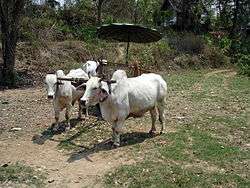
Vērši
Etymology
From Proto-Indo-European *aw-, *awe- (“to moisten, to sprinkle, to flow”) with an extra -rs (and with lengthening of the vowel, caused by the intonation: er̀ → è:r). The original meaning probably evolved from “one who inseminates” (i.e., from which seed flows) → “male” → “male cattle, ox.” Cognates include Lithuanian ver̃šis (“calf; (dialectal) ox”), Old Prussian werstian (“calf”) (maybe *wersistian?), Sanskrit वृष (vṛṣa, “bull; male”), वृषन् (vṛṣan, “man; stallion, ox”), Avestan 𐬬𐬀𐬭𐬱𐬥𐬌 (varšni, “ram”), Latin verrēs (“boar”).[1]
Pronunciation
- IPA(key): [vɛ̀ːrsis]
(file)
Noun
vērsis m (2nd declension)
- ox (male cattle, usually castrated, often used as a beast of burden)
- darba vērsis ― working ox
- vēršu pajūgs ― oxcart
- vērša gaļa ― ox (= cow) meat, beef
- vēršu cīņas ― ox fight (= bullfight, in Spain)
Declension
Declension of vērsis (2nd declension)
See also
References
- ↑ Karulis, Konstantīns (1992), “vērsis”, in Latviešu Etimoloģijas Vārdnīca (in Latvian), Rīga: AVOTS, →ISBN
This article is issued from
Wiktionary.
The text is licensed under Creative Commons - Attribution - Sharealike.
Additional terms may apply for the media files.