urethra
English
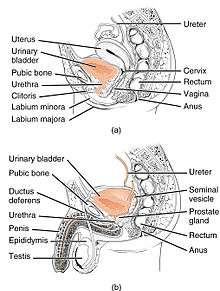
The urethra is labelled in these diagrams of the female and male genitourinary systems
Etymology
A learned borrowing from Ancient Greek οὐρήθρα (ourḗthra, “the passage for urine”), from οὐρέω (ouréō, “to make water”). Recorded in English since 1634.
Pronunciation
- (US) IPA(key): /jʊˈɹiːθɹə/
Noun
urethra (plural urethras or urethrae)
- (anatomy) The tube through which urine exits the body and, in males, through which semen is ejaculated.
Derived terms
Translations
anatomical tube
|
|
See also
Latin
Etymology
Borrowed from Ancient Greek οὐρήθρα (ourḗthra).
Pronunciation
- (Classical) IPA(key): /uːˈreː.tʰra/
Noun
ūrēthra f (genitive ūrēthrae); first declension
Inflection
First declension.
| Case | Singular | Plural |
|---|---|---|
| nominative | ūrēthra | ūrēthrae |
| genitive | ūrēthrae | ūrēthrārum |
| dative | ūrēthrae | ūrēthrīs |
| accusative | ūrēthram | ūrēthrās |
| ablative | ūrēthrā | ūrēthrīs |
| vocative | ūrēthra | ūrēthrae |
References
- urethra in Charlton T. Lewis and Charles Short (1879) A Latin Dictionary, Oxford: Clarendon Press
- urethra in Gaffiot, Félix (1934) Dictionnaire Illustré Latin-Français, Hachette
This article is issued from
Wiktionary.
The text is licensed under Creative Commons - Attribution - Sharealike.
Additional terms may apply for the media files.