tuyere
See also: tuyère
English
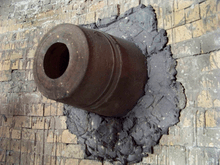
A tuyere, seen from inside an empty blast furnace.
Alternative forms
Etymology
From French tuyère, from Middle French tuyere, from Old French toiere (“pipe-hole”), from tuyau, tueil, tudel (“pipe”), from Frankish *thūta (“pipe”), from Proto-Germanic *þeutǭ (“pipe, channel, flow”), from *þeutaną (“to howl, roar, resound”), from Proto-Indo-European *tu-, *tutu- (“bird-cry, shriek”). Cognate with Old Saxon theuta (“pipe, water-channel”), Old High German watardioza (“water-opening”), Old English þēote (“pipe, channel”), Dutch tuit (“spout, nozzle”), Icelandic þjótandi (“the name of an artery”), Icelandic þjóta (“to rush, whistle”).
Pronunciation
- IPA(key): /twiˈjɛɹ/, /twiˈjɪɹ/, /tuˈjɛɹ/
- Hyphenation: tu‧yere
Noun
tuyere (plural tuyeres)
- A nozzle or similar fixture through which the blast is delivered to the interior of a blast furnace, or to the fire of a forge
- 1957, H.R. Schubert, History of the British Iron and Steel Industry, page 21:
- Remains of a clay tuyere are present through which the blast was conducted into the furnace.
-
Synonyms
Translations
This article is issued from
Wiktionary.
The text is licensed under Creative Commons - Attribution - Sharealike.
Additional terms may apply for the media files.