trompe l'oeil
English
WOTD – 15 May 2011
Alternative forms
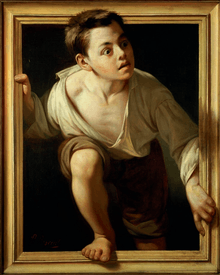
Trompe l'oeil of a portrait subject escaping his frame.
Etymology
Borrowed from French trompe-l’œil (literally “deceives the eye”), from trompe (“deceives”, third-person singular present indicative of tromper) + l’ (“the”, prevocalic form of le) + œil (“eye”).
Pronunciation
- (Received Pronunciation) enPR: tʀôɴp löy, IPA(key): /tʁɔ̃p lœj/
Noun
trompe l’oeil (usually uncountable, plural trompe l’oeil or trompe l’oeils) (see usage notes)
- (uncountable) A genre of painting that exploits human vision to create the illusion that the subject of the painting is real.
- (countable) A painting of this kind.
Usage notes
- This phrase is sometimes misconstructed as trompe d’œil and trompe-d’œil, which, literally interpreted in French, means “deceives of eye”.
- In French, trompe-l’œil is an invariant noun; the same usage is reflected in the plural use of the English trompe l’oeil. Alternatively, trompe l’oeil is treated as a headless noun phrase, to which is suffixed -s to form a regular plural form. Still otherwise, some authors form novel plurals on modified etymological bases, such as the technically correct trompent-l’œil (“[they] deceive the eye”) and the ultimately mistaken trompe les yeux (“deceives the eyes”); however, such neologistic constructions are vanishingly rare.
Synonyms
Translations
genre of still life painting
|
|
painting of this kind
|
|
See also
-

References
- “‖trompe l’œil” listed in the Oxford English Dictionary [2nd Ed.; 1989]
French
Noun
trompe l'oeil m (plural trompe l'oeil)
- Misspelling of trompe-l’œil.
Italian
Etymology
Noun
trompe l'oeil m (invariable)
This article is issued from
Wiktionary.
The text is licensed under Creative Commons - Attribution - Sharealike.
Additional terms may apply for the media files.