teixo
Galician
Etymology 1
From Latin taxus, from Scythian.
Pronunciation
- IPA(key): /ˈtejʃo̝/
Noun
teixo m (plural teixos)
- (botany) yew
- 1409, José Luis Pensado Tomé (ed.), Tratado de Albeitaria. Santiago de Compostela: Centro Ramón Piñeiro, page 129:
- Para desfazer aquel callo ual moyto o maluisco et a Rayz do lilio et a Rayz do teixo
- the marshmallow, the lily root, and the yew root, are very useful for undoing that callosity
- Para desfazer aquel callo ual moyto o maluisco et a Rayz do lilio et a Rayz do teixo
- 1409, José Luis Pensado Tomé (ed.), Tratado de Albeitaria. Santiago de Compostela: Centro Ramón Piñeiro, page 129:
Derived terms
- teixeira
Etymology 2
From late Vulgar Latin taxus (“badger”), from Proto-Germanic *þahsuz (“badger”)[1] or either from Proto-Celtic *tasko- (“badger”).[2][3]
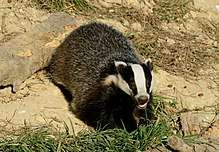
teixo / teixugo / porco teixo
Pronunciation
- IPA(key): /ˈtejʃo̝/
Noun
teixo m (plural teixos)
Related terms
- porco teixo, teixón, teixugo
Adjective
teixo m (feminine singular teixa, masculine plural teixos, feminine plural teixas)
- dark brown to reddish yellow (applied to cows and other animals)
- severe, unsociable
References
- “teix” in Xavier Varela Barreiro & Xavier Gómez Guinovart: Corpus Xelmírez - Corpus lingüístico da Galicia medieval. SLI / Grupo TALG / ILG, 2006-2016.
- “teixo” in Dicionario de Dicionarios da lingua galega, SLI - ILGA 2006-2013.
- “teixo” in Santamarina, Antón (coord.): Tesouro informatizado da lingua galega. Santiago de Compostela: Instituto da Lingua Galega.
- “teixo” in Álvarez, Rosario (coord.): Tesouro do léxico patrimonial galego e portugués, Santiago de Compostela: Instituto da Lingua Galega.
- ↑ Coromines, Joan; Pascual, José A. (1991–1997). Diccionario crítico etimológico castellano e hispánico. Madrid: Gredos, s.v. tejón.
- ↑ Matasović, Ranko (2009) Etymological Dictionary of Proto-Celtic (Leiden Indo-European Etymological Dictionary Series; 9), Leiden: Brill, →ISBN.
- ↑ Grzega, Joachim (2001) Romania Gallica Cisalpina etymologisch-geolinguistische Studien zu den oberitalienisch-rätoromanischen Keltizismen, Tübingen: M. Niemeyer, →ISBN, page 240 – via De Gruyter.
Portuguese
.jpg)
teixo (Taxus baccata)
Etymology
Pronunciation
- (Portugal) IPA(key): /ˈtɐj.ʃu/, /ˈtej.ʃu/
- (Brazil) IPA(key): /ˈtej.ʃu/
- (South Brazil) IPA(key): /ˈtej.ʃo/
Noun
teixo m (plural teixos)
Related terms
This article is issued from
Wiktionary.
The text is licensed under Creative Commons - Attribution - Sharealike.
Additional terms may apply for the media files.