sistrum
English
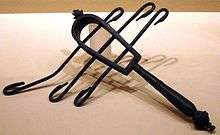
A Roman sistrum
Etymology
Borrowed from Latin sīstrum, itself a borrowing from Ancient Greek σεῖστρον (seîstron), from σείω (seíō, “shake”).
Pronunciation
- IPA(key): /ˈsɪstɹəm/
Noun
sistrum (plural sistrums or sistra)
- An ancient Egyptian musical instrument, to be shaken, consisting of a metal frame holding percussive metal beads.
- 1983, Norman Mailer, Ancient Evenings:
- She moved with slow undulations of her body as lascivious as the curve of Hathfertiti’s hair, and the sistrum with its singing wires was played by a dwarf wearing nothing but a gold purse and a few bracelets on his stunted biceps.
- 1983, Norman Mailer, Ancient Evenings:
Translations
See also

Anagrams
Latin
Etymology
Borrowed from Ancient Greek σεῖστρον (seîstron), from σείω (seíō, “shake”).
Pronunciation
- (Classical) IPA(key): /ˈsiːs.trum/, [ˈsiːs.trũ]
Noun
sīstrum n (genitive sīstrī); second declension
Inflection
Second declension.
| Case | Singular | Plural |
|---|---|---|
| nominative | sīstrum | sīstra |
| genitive | sīstrī | sīstrōrum |
| dative | sīstrō | sīstrīs |
| accusative | sīstrum | sīstra |
| ablative | sīstrō | sīstrīs |
| vocative | sīstrum | sīstra |
Descendants
Further reading
- sistrum in Charlton T. Lewis and Charles Short (1879) A Latin Dictionary, Oxford: Clarendon Press
- sistrum in Charlton T. Lewis (1891) An Elementary Latin Dictionary, New York: Harper & Brothers
- sistrum in Gaffiot, Félix (1934) Dictionnaire Illustré Latin-Français, Hachette
- sistrum in Harry Thurston Peck, editor (1898) Harper's Dictionary of Classical Antiquities, New York: Harper & Brothers
- sistrum in William Smith et al., editor (1890) A Dictionary of Greek and Roman Antiquities, London: William Wayte. G. E. Marindin
This article is issued from
Wiktionary.
The text is licensed under Creative Commons - Attribution - Sharealike.
Additional terms may apply for the media files.