rug
English
Etymology
Origin uncertain; probably of North Germanic origin, compare dialectal Norwegian rugga (“coarse coverlet”), Swedish rugg (“rough entangled hair”), from Old Norse rǫgg (“shagginess; tuft”), from Proto-Germanic *rawwō (“long wool”), related to English rag and rough.
Pronunciation
- enPR: rŭg, IPA(key): /ɹʌɡ/
- Rhymes: -ʌɡ
Noun
rug (plural rugs)
- A partial covering for a floor. [1624]
- (Britain, Australia) A (usually thick) piece of fabric used for warmth (especially on a bed); a blanket. [1591]
- 1855, William Howitt, A Boy′s Adventures in the Wilds of Australia: or, Herbert′s Note-Book, page 254,
- They then cut down a quantity of gum-tree leaves for a bed, and threw their rugs upon them ready for bed-time.
- 1906 July 27, Government Gazette of Western Australia, page 2297,
- Furnish every sleeping apartment with a sufficient number of toilet utensils and bedsteads, and sufficient bedding so that each bed shall be provided with a mattress, two sheets, a rug, and, in winter time, not less than one additional rug.
- 1950 April, Dental Journal of Australia, Volume 22, page 181,
- My own son had a bunny rug of which he was very fond and on being put to bed he would always demand his “bunny rug to suck his finger with.″
- 1958, Arthur Hailey, John Castle. Runway Zero-Eight. Bantham Books
- She tucked in a rug round the woman. “How’s that?” The woman nodded gratefully.
- 1997, Alan Sharpe, Vivien Encel, Murder!: 25 True Australian Crimes, page 22,
- He brought with him a rug and a sheet, and lay down by the fire.
- 1855, William Howitt, A Boy′s Adventures in the Wilds of Australia: or, Herbert′s Note-Book, page 254,
- (historical, now rare) A kind of coarse, heavy frieze, formerly used for clothing. [1547]
- Holinshed
- They spin the choicest rug in Ireland. A friend of mine […] repaired to Paris Garden clad in one of these Waterford rugs.
- Holinshed
- (historical, now rare) A cloak or mantle made of such a frieze. [1577]
- (obsolete, rare) A person wearing a rug. [1627]
- A cloth covering for a horse. [1790]
- (obsolete, rare) A dense layer of natural vegetation that precludes the growth of crops. [1792]
- (slang) The female pubic hair. [1893]
- A rough, woolly, or shaggy dog.
- (slang) A wig; a hairpiece. [1940]
- (colloquial) A dense growth of chest hair. [1954]
Usage notes
- (partial floor covering): The terms rug and carpet are not precise synonyms: a rug covers part of the floor; a carpet covers most or a large area of the floor; a fitted carpet runs wall-to-wall.
Synonyms
Derived terms
Translations
|
|
|
|
Verb
rug (third-person singular simple present rugs, present participle rugging, simple past and past participle rugged)
- (Scotland) To pull roughly or hastily; to plunder; to spoil; to tear.
- (Can we find and add a quotation of Sir Walter Scott to this entry?)
Derived terms
Part or all of this entry has been imported from the 1913 edition of Webster’s Dictionary, which is now free of copyright and hence in the public domain. The imported definitions may be significantly out of date, and any more recent senses may be completely missing.
(See the entry for rug in Webster’s Revised Unabridged Dictionary, G. & C. Merriam, 1913.)
Further reading
Anagrams
Afrikaans
Etymology
Noun
rug (plural rûe or rûens, diminutive ruggie)
Danish
Etymology
From Old Danish rugh, from Old Norse rugr, from Proto-Germanic *rugiz, from Proto-Indo-European *wrugʰyo-. Compare Norwegian Bokmål rug, Swedish råg, Icelandic rúgur, Dutch rogge, Low German Rogg, German Roggen, English rye.
Noun
rug c (singular definite rugen, not used in plural form)
Verb
rug
- imperative of ruge
Dutch
Etymology
From Middle Dutch rugge, from Old Dutch ruggi, from Proto-Germanic *hrugjaz.
Pronunciation
- Rhymes: -ʏx
- IPA(key): /rʏx/
audio (file)
Noun
rug m (plural ruggen, diminutive ruggetje n or rugje n)
Derived terms
Descendants
- Afrikaans: rug
Irish
Etymology
From Old Irish ·ruc, prototonic form of ro·ucc, perfect tense of beirid.
Pronunciation
- IPA(key): [ɾˠʊɡ]
Verb
rug
- past analytic of beir
Further reading
- "rug" in Foclóir Gaeilge-Béarla, An Gúm, 1977, by Niall Ó Dónaill.
- Entries containing “rug” in English-Irish Dictionary, An Gúm, 1959, by Tomás de Bhaldraithe.
- Entries containing “rug” in New English-Irish Dictionary by Foras na Gaeilge.
Manx
Verb
rug (verbal noun ruggal, past participle ruggit)
- to bear (give birth to)
Synonyms
Norwegian Bokmål
Etymology
From Old Norse rugr, from Proto-Germanic *rugiz, from Proto-Indo-European *wrugʰyo-. Compare Danish rug, Swedish råg, Icelandic rúgur, Dutch rogge, German Roggen, English rye.
Noun
rug m (definite singular rugen)
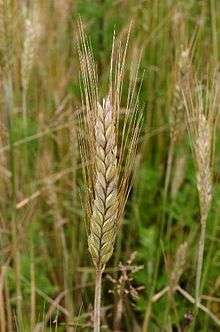
- rye (the grass Secale cereale or its grains as food)
Derived terms
References
- “rug” in The Bokmål Dictionary.
Norwegian Nynorsk
Etymology
From Old Norse rugr, from Proto-Germanic *rugiz, from Proto-Indo-European *wrugʰyo-. Compare Danish rug, Swedish råg, Icelandic rúgur, Dutch rogge, German Roggen, English rye.
Noun
rug m (definite singular rugen)
- rye (as above)
Derived terms
References
- “rug” in The Nynorsk Dictionary.
Romanian
Etymology 1
Noun
rug n (plural ruguri)
Declension
Etymology 2
From Latin rubus (“bramble, briar”).
Noun
rug m (plural rugi)
Declension
Scottish Gaelic
Pronunciation
- IPA(key): /rˠuk/
Verb
rug
- past tense of beir