pyrite
See also: Pyrite
English
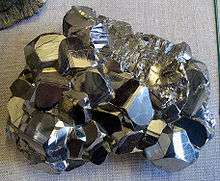
Pyrite
Etymology
Recorded since 1555, from Old French pyrite (12th century), from Latin pȳritēs, from Ancient Greek πυρίτης λίθος (purítēs líthos, “stone of fire, flint”) (so called because it glitters), notably the first part: adjective πυρίτης (purítēs, “of or in fire”), from πῦρ (pûr, “fire”).
Pronunciation
- IPA(key): /ˈpaɪ.ɹaɪt/
- Hyphenation: py‧rite
Noun
pyrite (plural pyrites)
- (mineralogy) The common mineral iron disulfide (FeS2), of a pale brass-yellow color and brilliant metallic luster, crystallizing in the isometric system.
- (usually as a plural: pyrites) Any metallic-looking sulphide, such as the above, which is the most common.
- (solid state chemistry) (usually as a plural: pyrites) Any metal dichalcogenide that is isostructural to the common mineral.
- Copper diselenide can occur both as a marcasite and a pyrite.
Synonyms
- fool's gold
- iron pyrites
Hyponyms
- iron pyrite
- pyrrhotite
Derived terms
Terms derived from pyrite
|
Related terms
Translations
mineral iron disulfide
See also
Anagrams
French
Pronunciation
- IPA(key): /pi.ʁit/
- Hyphenation: py‧rite
Noun
pyrite m (plural pyrites)
- The metallic mineral pyrite
Hyponyms
Related terms
- pyrique
Further reading
- “pyrite” in le Trésor de la langue française informatisé (The Digitized Treasury of the French Language).
This article is issued from
Wiktionary.
The text is licensed under Creative Commons - Attribution - Sharealike.
Additional terms may apply for the media files.