porcus
Latin
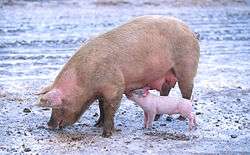
porcus fēmina et porculus (a female pig and piglet)
Etymology
From Proto-Italic *porkos, from Proto-Indo-European *pórḱos (“young swine, young pig”). Cognate with Old English fearh (“young pig, hog”). More at farrow. Compare also Ancient Greek πόρκος (pórkos).
Pronunciation
- (Classical) IPA(key): /ˈpor.kus/, [ˈpɔr.kʊs]
-
Audio (Classical) (file)
Noun
porcus m (genitive porcī); second declension
- a pig, hog, a tame swine
- (pejorative) glutton, pig
- (porcus marīnus) the sea-hog, mereswine, porpoise
- pudenda muliebria, woman parts
- (military) a wedge-shaped battle formation
Usage notes
- For the semantic shift of “pig” to “female genitalia”, compare the same Ancient Greek use of χοῖρος (khoîros).
Inflection
Second declension.
| Case | Singular | Plural |
|---|---|---|
| nominative | porcus | porcī |
| genitive | porcī | porcōrum |
| dative | porcō | porcīs |
| accusative | porcum | porcōs |
| ablative | porcō | porcīs |
| vocative | porce | porcī |
Synonyms
- (pig): sūs
- (battle formation): caput porcī
Derived terms
Descendants
- Aromanian: porcu
- Asturian: puercu
- Catalan: porc
- Corsican: porcu
- Dalmatian: puarc
- English: pork
- Esperanto: porko
- Friulian: purcit
- Ido: porko
- Interlingua: porco
- Italian: porco
- Ligurian: pòrco
- Occitan: pòrc
- Old French: porc
- French: porc
- Old Portuguese: porco
- Romanian: porc
- Romansch: portg
- Sardinian: porcu
- Sicilian: porcu
- Spanish: puerco
- Venetian: porco
References
- porcus in Charlton T. Lewis and Charles Short (1879) A Latin Dictionary, Oxford: Clarendon Press
- porcus in Charlton T. Lewis (1891) An Elementary Latin Dictionary, New York: Harper & Brothers
- porcus in Charles du Fresne du Cange’s Glossarium Mediæ et Infimæ Latinitatis (augmented edition, 1883–1887)
- porcus in Gaffiot, Félix (1934) Dictionnaire Illustré Latin-Français, Hachette
Anagrams
This article is issued from
Wiktionary.
The text is licensed under Creative Commons - Attribution - Sharealike.
Additional terms may apply for the media files.