pando
See also: Pando
Esperanto
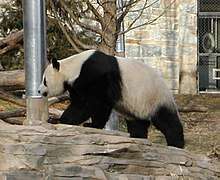
Pando.
Etymology
Pronunciation
- IPA(key): /ˈpan.do/
- Hyphenation: pan‧do
Noun
pando (accusative singular pandon, plural pandoj, accusative plural pandojn)
Hyponyms
- pandidino (“female panda cub”)
- pandido (“panda cub”)
- pandino (“she-panda”)
- virpando (“male panda”)
Holonyms
- pandaro (“pack of pandas”)
Latin
Etymology 1
For *patnō, from Proto-Indo-European *peth₂- (“to spread out”). Cognate with pateō, Ancient Greek πέταλον (pétalon, “leaf”).
Pronunciation
- (Classical) IPA(key): /ˈpan.doː/
Verb
pandō (present infinitive pandere, perfect active pandī, supine passum); third conjugation
Inflection
Derived terms
Descendants
Etymology 2
From Latin pandus
Verb
pandō (present infinitive pandāre, perfect active pandāvī, supine pandātum); first conjugation
Inflection
Descendants
References
- pando1 in Charlton T. Lewis and Charles Short (1879) A Latin Dictionary, Oxford: Clarendon Press
- pando2 in Charlton T. Lewis and Charles Short (1879) A Latin Dictionary, Oxford: Clarendon Press
- pando in Charlton T. Lewis (1891) An Elementary Latin Dictionary, New York: Harper & Brothers
- pando in Gaffiot, Félix (1934) Dictionnaire Illustré Latin-Français, Hachette
- Carl Meissner; Henry William Auden (1894) Latin Phrase-Book, London: Macmillan and Co.
- to set the sails: vela facere, pandere
- to set the sails: vela facere, pandere
Spanish
Adjective
pando (feminine singular panda, masculine plural pandos, feminine plural pandas)
Noun
pando m (plural pandos)
- plane (open flat land between mountains)
Synonyms
Derived terms
This article is issued from
Wiktionary.
The text is licensed under Creative Commons - Attribution - Sharealike.
Additional terms may apply for the media files.