opal
English
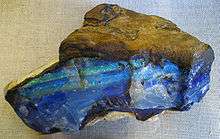
Banded opal, a variety of opal (1)
Etymology
In Florio’s A World of Words 1598 as opale, from French opale, from Latin opalus, from Byzantine Greek ὀπάλλιος (opállios), from Sanskrit उपल (upala, “gem, stone”), from उपरि (upari, “the upper millstone”).[1].
Pronunciation
Noun
opal (plural opals)
- (mineralogy) A mineral consisting, like quartz, of silica, but inferior to quartz in hardness and specific gravity, of the chemical formula SiO2·nH2O.
- 2012 March 1, Lee A. Groat, “Gemstones”, in American Scientist, volume 100, number 2, page 128:
- Although there are dozens of different types of gems, among the best known and most important are […] . (Common gem materials not addressed in this article include amber, amethyst, chalcedony, garnet, lazurite, malachite, opals, peridot, rhodonite, spinel, tourmaline, turquoise and zircon.)
-
- (biology, genetics, biochemistry) A colloquial name used in molecular biology referring to a particular stop codon sequence, "UGA."
Derived terms
Translations
a mineral consisting, like quartz, of silica, but inferior to quartz in hardness and specific gravity
Further reading
- “Opal” in David Barthelmy, Webmineral Mineralogy Database, 1997–.
- opal mindat.org, Hudson Institute of Mineralogy, accessed 29 August 2016
- ↑ Chambers Dictionary of Etymology, Robert K. Barnhart (ed.), Chambers, 1988
Anagrams
Cebuano
Etymology
From English opal, from French opale, from Latin opalus, from Byzantine Greek ὀπάλλιος (opállios), from Sanskrit उपल (upala, “gem, stone”), from उपरि (upari, “the upper millstone”).
Pronunciation
- Hyphenation: o‧pal
Noun
opal
- (mineralogy) opal
Polish
Pronunciation
- IPA(key): /ˈɔ.pal/
Audio (file)
Noun
opal m inan
Declension
Derived terms
This article is issued from
Wiktionary.
The text is licensed under Creative Commons - Attribution - Sharealike.
Additional terms may apply for the media files.