nauplius
See also: Nauplius
English
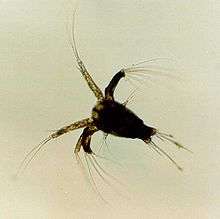
A shrimp nauplius
Etymology
From Latin, from Ancient Greek ναύπλιος (naúplios, “a kind of shellfish”). See Ναύπλιος (Naúplios).
Noun
nauplius (plural nauplii)
- A crustacean larva that has three pairs of locomotive organs (corresponding to antennules, antennae, and mandibles), a median eye, and little or no segmentation of the body.
- 2001, Naureen A. Qureshi, Nancy N. Rabalais, 4: Distribution of Zooplankton on a Seasonally Hypoxic Continental Shelf, Nancy N. Rabalais, R. Eugene Turner (editors), Coastal Hypoxia: Consequences for Living Resources and Ecosystems, page 72,
- The copepod nauplii concentrations were significantly different among stations and by depth (Appendices 3 and 4).
- 2003, Donald I. Williamson, The Origins of Larvae, page 172,
- I suggest that several species of nauplioids hybridized with representatives of several groups of arthropods to give them nauplius larvae.
- 2007, Food and Agricultural Organization of the UN, Improving Penaeus monodon hatchery practices: Manual based on experience in India, FAO Fisheries Technical Paper 446, page 47,
- Only nauplii that are attracted to the light at the top of the hatching tank should be collected, since these are the healthy ones.
- 2001, Naureen A. Qureshi, Nancy N. Rabalais, 4: Distribution of Zooplankton on a Seasonally Hypoxic Continental Shelf, Nancy N. Rabalais, R. Eugene Turner (editors), Coastal Hypoxia: Consequences for Living Resources and Ecosystems, page 72,
Derived terms
Translations
This article is issued from
Wiktionary.
The text is licensed under Creative Commons - Attribution - Sharealike.
Additional terms may apply for the media files.