muse
English
WOTD – 27 February 2008
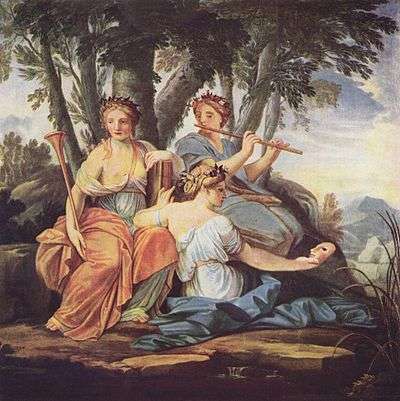
Three musæ Clio, Euterpe, and Thalia
Pronunciation
Etymology 1
From Middle French muse, from Latin Mūsa, from Ancient Greek Μοῦσα (Moûsa).
Noun
muse (plural muses)
- A source of inspiration.
- (archaic) A poet; a bard.
- (Can we find and add a quotation of Milton to this entry?)
Usage notes
Synonyms
- (source of inspiration): Pierian spring
Related terms
Translations
a source of inspiration
Etymology 2
From Middle English musen, from Old French muser.
Verb
muse (third-person singular simple present muses, present participle musing, simple past and past participle mused)
- (intransitive) To become lost in thought, to ponder.
- (transitive) To say (something) with due consideration or thought.
- For quotations of use of this term, see Citations:muse.
- (transitive) To think on; to meditate on.
- (Can we date this quote?) Thomson
- Come, then, expressive Silence, muse his praise.
- 2013 June 7, David Simpson, “Fantasy of navigation”, in The Guardian Weekly, volume 188, number 26, page 36:
- It is tempting to speculate about the incentives or compulsions that might explain why anyone would take to the skies in [the] basket [of a balloon]: […]; […]; or perhaps to muse on the irrelevance of the borders that separate nation states and keep people from understanding their shared environment.
- (Can we date this quote?) Thomson
- (transitive) To wonder at.
- (Can we find and add a quotation of Shakespeare to this entry?)
Synonyms
- See also Thesaurus:ponder
Related terms
Translations
to become lost in thought
to say with due consideration
to think on; to meditate on
to wonder at
Noun
muse (plural muses)
- An act of musing; a period of thoughtfulness.
- 1590, Edmund Spenser, The Faerie Queene, I.xii:
- still he sate long time astonished / As in great muse, ne word to creature spake.
- 1978, Lawrence Durrell, Livia, Faber & Faber 1992 (Avignon Quintet), p. 416:
- He fell into a muse and pulled his upper lip.
- 1590, Edmund Spenser, The Faerie Queene, I.xii:
Etymology 3
Noun
muse (plural muses)
- A gap or hole in a hedge, fence, etc. through which a wild animal is accustomed to pass; a muset.
- Find a hare without a muse. (old proverb)
Anagrams
French
Pronunciation
Noun
muse f (plural muses)
- artistic inspiration
- muse (specific artistic subject)
Verb
muse
Anagrams
Italian
Noun
muse f
- plural of musa
Anagrams
Middle English
Noun
muse
- Alternative form of mous
Norwegian Bokmål
Etymology
From French musée, from Latin mūsēum, from Ancient Greek Μουσεῖον (Mouseîon)
Pronunciation
- IPA(key): /mʉ.seː/, [mʉʷ.ˈseː]
Noun
muse n (definite singular museet, indefinite plural muse or museer, definite plural museene or musea)
- Alternative form of musé
References
“muse” in The Bokmål Dictionary.
Norwegian Nynorsk
Etymology
From French musée, from Latin mūsēum, from Ancient Greek Μουσεῖον (Mouseîon)
Pronunciation
- IPA(key): /mʉ.seː/, [mʉʷ.ˈseː]
Noun
muse n (definite singular museet, indefinite plural muse, definite plural musea)
- Alternative form of musé
References
“muse” in The Nynorsk Dictionary.
Spanish
Verb
muse
This article is issued from
Wiktionary.
The text is licensed under Creative Commons - Attribution - Sharealike.
Additional terms may apply for the media files.