musca
Latin
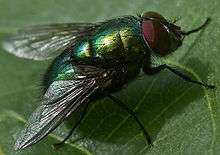
musca (a fly)
Etymology
From a Proto-Indo-European root *mus-, *mu-, *mew-. Cognates with the Sanskrit मशक (maśáka), Old Church Slavonic моуха (muxa), and the Ancient Greek μυῖα (muîa, “a fly”) of which μυἱσκα (mhuiska) may be a diminutive form. Confer the German Mücke (“mosquito”) and English midge, midget and mosquito (the latter is from Spanish, and it is a diminutive of mosca, from musca).
Pronunciation
- (Classical) IPA(key): /ˈmus.ka/, [ˈmʊs.ka]
Noun
musca f (genitive muscae); first declension
- a fly (insect)
- Puer, abige muscas.
- Repel those flies, boy.
- Puer, abige muscas.
- (transferred meaning) an inquisitive or prying people
Inflection
First declension.
| Case | Singular | Plural |
|---|---|---|
| nominative | musca | muscae |
| genitive | muscae | muscārum |
| dative | muscae | muscīs |
| accusative | muscam | muscās |
| ablative | muscā | muscīs |
| vocative | musca | muscae |
Derived terms
Descendants
References
- musca in Charlton T. Lewis and Charles Short (1879) A Latin Dictionary, Oxford: Clarendon Press
- musca in Charlton T. Lewis (1891) An Elementary Latin Dictionary, New York: Harper & Brothers
- musca in Charles du Fresne du Cange’s Glossarium Mediæ et Infimæ Latinitatis (augmented edition, 1883–1887)
- musca in Gaffiot, Félix (1934) Dictionnaire Illustré Latin-Français, Hachette
- musca in Ramminger, Johann (accessed 16 July 2016) Neulateinische Wortliste: Ein Wörterbuch des Lateinischen von Petrarca bis 1700, pre-publication website, 2005-2016
- musca in William Smith, editor (1848) A Dictionary of Greek Biography and Mythology, London: John Murray
Romanian
Noun
musca f
- definite singular nominative and accusative form of muscă.
This article is issued from
Wiktionary.
The text is licensed under Creative Commons - Attribution - Sharealike.
Additional terms may apply for the media files.