morion
English
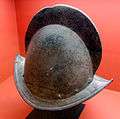
Spanish conqueror morion
Pronunciation
- (UK) IPA(key): /ˈmɒɹɪən/
Etymology 1
From Middle French morion, and its source, Spanish morrión, probably from morra (“crown of the head”). Perhaps compare moraine.
Noun
morion (plural morions)
- (historical) A kind of open brimmed helmet used by footsoldiers in the 16th and 17th centuries, having no visor or bever. [from 16th c.]
- 1603, John Florio, transl.; Michel de Montaigne, The Essayes, […], printed at London: […] Edward Blount […], OCLC 946730821:, II.9:
- The Roman footmen caried not their morions, sword and target only, as for other armes (saith Cicero) they were so accustomed to weare them continually, that they hindered them no more than their limbs […].
- 1786, Francis Grose, A Treatise on Ancient Armour and Weapons, p.12:
- The morion is a kind of open helmet, without visor or bever, somewhat resembling a hat; it was commonly worn by the harqubussiers and musqueteers.
-
Translations
type of helmet
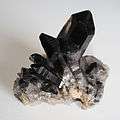
Smoky quartz/morion
Etymology 2
From French morion, from Late Latin morion, a misreading in some manuscripts for Latin mormorion.
Noun
morion (plural morions)
- (mineralogy) A brown or black variety of quartz. [from 18th c.]
Anagrams
French
Etymology
From Spanish morrión, from morro (“spherical object”), from Vulgar Latin *murrum (“muzzle, snout”).
Pronunciation
- IPA(key): /mɔʁjɔ̃/
Noun
morion m (plural morions)
Further reading
- “morion” in le Trésor de la langue française informatisé (The Digitized Treasury of the French Language).
Middle French
Noun
morion m (plural morions)
This article is issued from
Wiktionary.
The text is licensed under Creative Commons - Attribution - Sharealike.
Additional terms may apply for the media files.