kantele
English
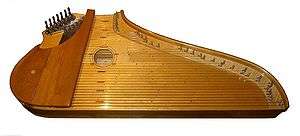
A kantele.
Etymology
From Finnish kantele, from a Baltic language, from Proto-Baltic *kantla.[1]
Pronunciation
- (UK) IPA(key): /ˈkantələ/, /ˈkɑːntəleɪ/
Noun
kantele (plural kanteles)
- (music) A plucked string instrument (a zither) of the Baltic psaltery family, traditionally with five strings but now more widely varying, originating in the folk music of Finland, where it is seen as a national symbol.[2]
- 1989, Keith Bosley, translating Elias Lönnrot, The Kalevala, XLIV:
- With his fingers Väinämöinen played / with its strings the kantele rang out […].
- 1989, Keith Bosley, translating Elias Lönnrot, The Kalevala, XLIV:
Hypernyms
Hyponyms
- concert kantele
- small kantele
See also
- Appendix:Glossary of chordophones
References
- ↑ Sihler, Andrew L. (1995) New Comparative Grammar of Greek and Latin, Oxford, New York: Oxford University Press, →ISBN, page 210
- ↑ 2003. "Kantele". Continuum Encyclopedia of Popular Music. Pg. 440.
Translations
traditional Finnish string instrument
Dutch
Verb
kantele
- (archaic) singular present subjunctive of kantelen
Anagrams
Finnish
Etymology 1
Alternative forms
Noun
kantele
Declension
Declension of kantele (type askel)
|
Etymology 2
Verb
kantele
This article is issued from
Wiktionary.
The text is licensed under Creative Commons - Attribution - Sharealike.
Additional terms may apply for the media files.