hombre
English
Etymology
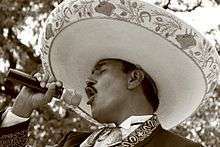
Borrowed from Spanish hombre (“man; human being”), from Old Spanish omne, from Latin hominem, accusative of homō (“a human being, a person”), from Old Latin hemō, from Proto-Italic *hemō (“man”), from Proto-Indo-European *ǵʰmṓ (“earthling”), from *dʰéǵʰōm (“earth”).
Pronunciation
- (Received Pronunciation) IPA(key): /ˈɒmbɹeɪ/, /-bɹi/
- (General American) IPA(key): /ˈɑmbɹeɪ/, /ˈʌmbɹeɪ/, /-bɹi/
Audio (US) (file) - Hyphenation: hom‧bre
Noun
hombre (plural hombres)
- (chiefly US, in Spanish-speaking contexts, slang) A man, a chap, a guy; especially a Hispanic or Spanish man.
- He's one tough hombre.
- c. 1850, [Thomas] Mayne Reid, “A Group of Jarochos”, in The Guerilla Chief, and Other Tales, London: C. H. Clarke, 13, Paternoster Row, OCLC 248586966, page 62:
- [W]e're glad to learn that the Yankee bullet has not quite stopped your breath. You're all right, hombre!
- 1852 March 8, E. P., “Golden Correspondence.—No. 1”, in J[oseph] M. Church, editor, Church’s Bizarre. For Fireside and Wayside, volume I, number 1 (New Series), Philadelphia, Pa.: Church & Co., 140 Chestnut Street, published 17 April 1852, OCLC 667127446, page 9, column 2:
- That hombre now with the worn out hat, tattered shirt, and fragmentary breeches, wears a sword. Bless you, his dignity would suffer greatly without it!
- 2010, Jon Sharpe [pseudonym], chapter 1, in Rocky Mountain Revenge (The Trailsman; no. 342), New York, N.Y.: Signet Books, New American Library, →ISBN:
- The foreman. As tough an hombre who ever lived. If Mr. Bell had sent Jackson instead of me, he'd take your rifle and beat you half to death with it.
- 2016, Lawrence Winkler, “Bajada”, in Orion’s Cartwheel (Cartwheels Quadrilogy; 1), Victoria, B.C.: First Choice Books, →ISBN, page 22:
- There was a pause I didn't like, punctuated by shrieks of shrill laughter from the hombres at the bar. Only Mexicans can laugh like that.
Further reading

Aragonese
Etymology
From Navarro-Aragonese hombre (“man”), from Latin homo, hominem (“man”).
Noun
hombre m
French
Pronunciation
Noun
hombre m (plural hombres)
Navarro-Aragonese
Etymology
From Latin homo, hominem (“man”).
Noun
hombre m
Descendants
Spanish
Alternative forms
Etymology
Through dissimilation from Old Spanish omne, from Latin hominem, accusative of homō, from Old Latin hemō, from Proto-Indo-European *ǵʰmṓ (“earthling”). Same source as the form omo (which does not exhibit diphthongisation). Compare Portuguese homem and Catalan home.
Pronunciation
- IPA(key): /ˈombɾe/, [ˈõmbɾe]
- Rhymes: -ombɾe
Noun
hombre m (plural hombres)
- Man, in the sense of adult male human.
- Man, in the sense of all humans collectively; mankind, humankind.
- (anthropology, archaeology, paleontology) man, in the sense of an individual of the species Homo sapiens, the genus Homo, or the subtribe Hominina.
- (colloquial) Husband.
- a top in male-male sex.
- a 17th century card game also called ombre.
Derived terms
(diminutive hombrecillo or hombrecito) (augmentative hombretón)
Synonyms
Antonyms
Interjection
¡hombre!