gyve
English
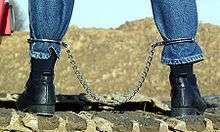
A woman's ankles gyved with gyves.
Alternative forms
Etymology
From Middle English *give, *gyve (found only in plural gives, gyves (“shackles; fetters”)). Of uncertain origin. Compare Welsh gefyn (“fetter, shackle”), Irish geibbionn (“fetters”), geimheal (“fetter, chain, shackle”).
The verb is from Middle English given, gyven (“to shackle”), from the noun.
Pronunciation
- IPA(key): /dʒaɪv/, /ɡaɪv/
- Rhymes: -aɪv
- Homophone: jive
Noun
gyve (plural gyves)
- A shackle or fetter, especially for the leg.
- Shakespeare, Romeo and Juliet
- Like a poor prisoner in his twisted gyves
- 1973, Kyril Bonfiglioli, Don't Point That Thing at Me, Penguin 2001, page 122
- Our gyves were removed and our possessions returned to us, except for my Banker's Special.
- Shakespeare, Romeo and Juliet
Verb
gyve (third-person singular simple present gyves, present participle gyving, simple past and past participle gyved)
Derived terms
Translations
shackle
Norwegian Nynorsk
Verb
gyve (present tense gyv, past tense gauv, past participle gove, present participle gyvande, imperative gyv)
- Alternative form of gyva
This article is issued from
Wiktionary.
The text is licensed under Creative Commons - Attribution - Sharealike.
Additional terms may apply for the media files.