grains of paradise
English
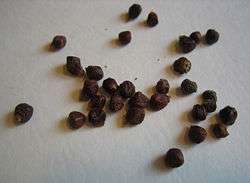
Grains of paradise.
Etymology
From medieval spice traders claiming that the spice grew only in Eden, in order to inflate prices.[1]
Noun
grains of paradise pl (plural only)
- The seeds of a plant (Aframomum melegueta) in the ginger family native to West Africa used as a spice.
- 1844, Jonathan Pereira, “On Grains of Paradise”, in The American Journal of Pharmacy, page 97:
- "Gærtner has figured the fruit and seeds of a scitamineous plant under the name of Zingiber Melægueta, and which he considered to be identical with the Grains of Paradise."
- 1994, Anthea Bell, A History of Food, Wiley-Blackwell, translation of original by Maguelonne Toussaint-Samat, →ISBN, page 495:
- "In fact this spice was making a second appearance in Europe: it was Guinea pepper, mentioned by Pliny as 'African pepper', and also known as Malaguetta pepper or grains of Paradise. Grains of Paradise had been very popular in the thirteenth century and again in the sixteenth; its popularity may have been due to the brilliant name thought up for it by some advertising genius born before his time."
- 2006, Susheela Raghavan, Handbook of Spices, Seasonings, and Flavorings, 2nd Edition edition, CRC Press, →ISBN, page 119:
- "Also called Melegueta or Malagueta pepper, guinea grain, or guinea pepper, grains of paradise were prized as a spice and as a substitute for black pepper in Europe during the Middle Ages."
-
Synonyms
- (Aframomum melegueta): alligator pepper, guinea grains, guinea pepper, melegueta pepper
Translations
spice
|
|
References
- ↑ “Grains of Paradise”, in (Please provide the title of the work), accessed 2009-06-08
Further reading



- grains of paradise at OneLook Dictionary Search
This article is issued from
Wiktionary.
The text is licensed under Creative Commons - Attribution - Sharealike.
Additional terms may apply for the media files.