gamma function
English
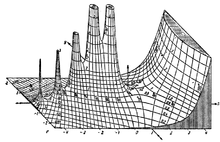
A hand-drawn graph of the absolute value of the gamma function for complex argument, from 1909, E. Jahnke, F. Emde, Funktionentafeln mit Formeln und Kurven (English title: Tables of Higher Functions)
Etymology
The function itself was initially defined as an integral (in modern representation, ) for positive real x by Swiss mathematician Leonhard Euler in 1730. The notation Γ(x) was introduced by Adrien-Marie Legendre. Both Euler's integral and Legendre's notation shift the argument with respect to the factorial, so that for integer n>0, Γ(n) = (n−1)!. Carl Friedrich Gauss preferred π(x), with no shift, but Legendre's notation prevailed. Generalisation to non-integer negative and to complex numbers was achieved by analytic continuation.[1]

Noun
gamma function (plural gamma functions)
- (mathematics, analysis) A meromorphic function which generalises the notion of factorial to complex numbers and has singularities at the nonpositive integers.
Hypernyms
Hyponyms
- digamma function
- incomplete gamma function
- polygamma function
- trigamma function
Translations
function which generalizes the notion of a factorial
|
|
References
- ↑ 1959, Philip J. Davis, Leonhard Euler's Integral: A Historical Profile of the Gamma Function, American Mathematical Monthly, Volume 66, Issue 10, pages 849-869, DOI 10.2307/2309786.
-

This article is issued from
Wiktionary.
The text is licensed under Creative Commons - Attribution - Sharealike.
Additional terms may apply for the media files.