emerald
See also: Emerald
English
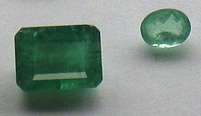
cut emeralds (beryl)
Etymology
From Middle English emeraude, from Old French esmeraude, from Vulgar Latin *esmaralda, *esmaraldus, variant of Latin smaragdus, from Ancient Greek σμάραγδος (smáragdos), μάραγδος (máragdos), from a Semitic language. Compare Hebrew בָּרֶקֶת (bareket) “emerald, flashing gem”, Akkadian Akkadian 𒁀𒊏𒄣 (baraqu, literally “scintillation”), Arabic بَرْق (barq, literally “flashing”), Egyptian bwyrqꜣ (literally “to sprarkle”):
|


and loanwords with Semitic etymon such as Sanskrit मरकत (marakata) and Persian زمرد (zomorrod) (whence Turkish zümrüt and Russian изумру́д (izumrúd)).
Pronunciation
- IPA(key): /ˈɛməɹəld/
Adjective
emerald (comparative more emerald, superlative most emerald)
- Of a rich green colour.
- Byron
- The insect-queen of eastern spring, / O'er emerald meadows of Kashmeer / Invites the young pursuer near, / And leads him on from flower to flower / A weary chase and wasted hour.
- Byron
Translations
rich green colour
|
|
Noun
emerald (countable and uncountable, plural emeralds)
- Any of various green gemstones, especially a green transparent form of beryl, highly valued as a precious stone.
- 2012 March 1, Lee A. Groat, “Gemstones”, in American Scientist, volume 100, number 2, page 128:
- Although there are dozens of different types of gems, among the best known and most important are diamond, ruby and sapphire, emerald and other gem forms of the mineral beryl, chrysoberyl, tanzanite, tsavorite, topaz and jade.
-
- Emerald green, a colour.
- (dated, printing, Britain) A size of type between nonpareil and minion, standardized as 6½-point.
Synonyms
- (gemstone): smaragd (obsolete)
- (type size, US): minionette
Translations
gemstone
|
|
colour
|
|
Derived terms
Terms derived from emerald
Related terms
See also
Further reading
This article is issued from
Wiktionary.
The text is licensed under Creative Commons - Attribution - Sharealike.
Additional terms may apply for the media files.