cumin
English
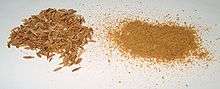
Cumin (spice): whole seeds, left; ground into powder, right.
Etymology
From Old English cymen and Old French cummin, both from Latin cuminum, from Ancient Greek κύμινον (kúminon). Cognate with Old High German kumin. Ultimately from a Semitic root, whence Hebrew כמון (kammon) and Arabic كَمُّون (kammūn).[1][2] Possibly related to caraway.
Pronunciation
- (Received Pronunciation) IPA(key): /ˈkʌmɪn/, /ˈkjuːmɪn/, enPR: kŭmʹĭn, kyo͞oʹmĭn
- (General American) IPA(key): /ˈkumɪn/, /ˈkjumɪn/, /ˈkʌmɪn/, /ˈkʊmɪn/, enPR: ko͞oʹmĭn
- Rhymes: -ʌmɪn, -juːmɪn
Noun
cumin (usually uncountable, plural cumins)
- The flowering plant Cuminum cyminum, in the family Apiaceae.
- Cumin is native to the region from the eastern Mediterranean to India.
- Its aromatic long seed, used as a spice, notably in Indian, Middle Eastern, and Mexican cookery.
Translations
plant Cuminum cyminum
|
|
its seed used as spice
|
|
- The translations below need to be checked and inserted above into the appropriate translation tables, removing any numbers. Numbers do not necessarily match those in definitions. See instructions at Wiktionary:Entry layout#Translations.
See also
References
- ↑ “cumin” in Dictionary.com Unabridged, Dictionary.com, LLC, 1995–present.
- ↑ “cumin” in Merriam-Webster Online Dictionary
Anagrams
French
Etymology
From Latin cuminum, from Ancient Greek κύμινον (kúminon), itself of Semitic origin.
Pronunciation
- IPA(key): /ky.mɛ̃/
audio (file)
Noun
cumin m (plural cumins)
- The plant cumin
- Its seed, a spice
Further reading
- “cumin” in le Trésor de la langue française informatisé (The Digitized Treasury of the French Language).
Romansch
Alternative forms
- (Vallader) cumün
Etymology
From Medieval Latin commūnia, neuter plural of Latin commūnis.
Noun
cumin m (plural cumins)
Synonyms
- (Rumantsch Grischun, Surmiran) vischnanca
- (Rumantsch Grischun, Sursilvan, Sutsilvan) vitg
This article is issued from
Wiktionary.
The text is licensed under Creative Commons - Attribution - Sharealike.
Additional terms may apply for the media files.