cotillion
English
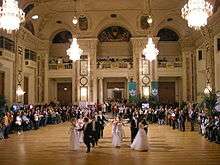
A cotillion ball
Alternative forms
Etymology
Circa 1750, in the sense of the dance, from French cotillon, originally “petticoat”, extended to the dance because of the distinctive lift of dress revealing the petticoat, from cotte (“dress”) + -illon (“(diminutive)”). Said to derive from the then popular song «Ma commere, quand je danse, Mon cotillion va-t-il bien».
Noun
cotillion (plural cotillions)
- A bold dance performed in groups of eight where ladies lift their skirts to display their ankles
- The music regulating the cotillion.
- 1848 I kept a parlor open for the reception of visitors, many came here to practise with me, and many more to listen to us—several young men put themselves under my tuition, and although I had never been taught myself, they progressed finely in their studies and I soon brought out, not only the best field music, but also for dinners, balls, cotilion and tea parties, weddings, &c. THRILLING SKETCH OF THE LIFE OF THE DISTINGUISHED CHIEF OKAH TUBBEE ALIAS, WM. CHUBBEE, Son of the Head Chief, Mosholeh Tubbee, of theChoctaw Nation of Indians. BY REV. L. L. ALLEN, AUTHOR OF “PENCILLINGS UPON THE RIO GRANDE,” &c. NEW YORK, 1848. ENTERED according to the Act of Congress, in the year 1848, by Okah Tubbee, alias William Chubbee, in the Clerk's Office of the District Court of the United States, for the Southern District of New York. AN ESSAY UPON THE INDIAN CHARACTER.
- A coming-of-age party meant to present girls newly transitioned into womanhood to the community for courtship
- A kind of woollen material for women's skirts.
Anagrams
This article is issued from
Wiktionary.
The text is licensed under Creative Commons - Attribution - Sharealike.
Additional terms may apply for the media files.