cauda
Dalmatian
Etymology
From Vulgar Latin cōda, from Latin cauda.
Noun
cauda f
Latin
Alternative forms
Etymology
From Proto-Italic *kaudā (“tail”), from Proto-Indo-European *keh₂u-d-eh₂, from *keh₂w-. Compare Lithuanian kuodas (“tuft”).[1]
Pronunciation
- (Classical) IPA(key): /ˈkau̯.da/
Noun
cauda f (genitive caudae); first declension
- A tail (of an animal)
Inflection
First declension.
| Case | Singular | Plural |
|---|---|---|
| nominative | cauda | caudae |
| genitive | caudae | caudārum |
| dative | caudae | caudīs |
| accusative | caudam | caudās |
| ablative | caudā | caudīs |
| vocative | cauda | caudae |
Antonyms
Derived terms
Descendants
All except modern borrowings are from the Late Latin form cōda
See also
References
- cauda in Charlton T. Lewis and Charles Short (1879) A Latin Dictionary, Oxford: Clarendon Press
- cauda in Charlton T. Lewis (1891) An Elementary Latin Dictionary, New York: Harper & Brothers
- cauda in Charles du Fresne du Cange’s Glossarium Mediæ et Infimæ Latinitatis (augmented edition, 1883–1887)
- cauda in Gaffiot, Félix (1934) Dictionnaire Illustré Latin-Français, Hachette
- ↑ Study of Language, Motilal Banarsidass Publ., 1994
Portuguese
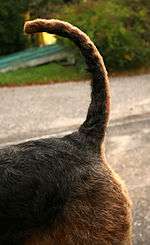
cauda
Etymology
From Old Portuguese, borrowed from Latin cauda. See also cola, inherited from the same origin.
Pronunciation
Noun
cauda f (plural caudas)
- tail (posterior appendage or feathers of some animals)
- tail; tail end (posterior part or appendage of an object)
- (figuratively) consequences
Synonyms
- (tail of an animal): rabo
- (empennage): empenagem
Related terms
Spanish
Noun
cauda f (plural caudas)
- tail (of a garment)
This article is issued from
Wiktionary.
The text is licensed under Creative Commons - Attribution - Sharealike.
Additional terms may apply for the media files.