canoe
English
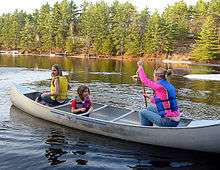
People in a canoe.
Etymology
Adopted in 16th century from Spanish canoa, from Taino *kanowa (“dugout canoe”) (compare Arawak kanoa (“canoe”), Wayuu anuwa, anua (“boat, canoe”)), from Proto-Arawakan *kanawa.
Pronunciation
- enPR: kə-no͞o', IPA(key): /kəˈnuː/
Audio (US) (file) - Rhymes: -uː
Noun
canoe (plural canoes)
- A small long and narrow boat, propelled by one or more people (depending on the size of canoe), using single-bladed paddles. The paddlers face in the direction of travel, in either a seated position, or kneeling on the bottom of the boat. Canoes are open on top, and pointed at both ends.
- 1907, Robert William Chambers, chapter IX, in The Younger Set (Project Gutenberg; EBook #14852), New York, N.Y.: D. Appleton & Company, published 1 February 2005 (Project Gutenberg version), OCLC 24962326:
- He and Gerald usually challenged the rollers in a sponson canoe when Gerald was there for the weekend; or, when Lansing came down, the two took long swims seaward or cruised about in Gerald's dory, clad in their swimming-suits; and Selwyn's youth became renewed in a manner almost ridiculous, […].
-
- (slang) An oversize, usually older, luxury car.
Descendants
- → Irish: canú
Translations
small long and narrow boat
|
|
slang: an oversized luxury car
Verb
canoe (third-person singular simple present canoes, present participle canoeing, simple past and past participle canoed)
Translations
Derived terms
See also
Further reading

Anagrams
Italian
Noun
canoe f
- plural of canoa
This article is issued from
Wiktionary.
The text is licensed under Creative Commons - Attribution - Sharealike.
Additional terms may apply for the media files.