boondoggle
English
WOTD – 16 May 2006
Etymology
Coined by Robert H. Link, American scout, 1929; alternatively “boon doggle”.[1] Compare woggle of similar sense, attested in same period.
In sense of “wasteful government program”, popularized in 1935 by The New York Times, in reference to New Deal programs which were claimed to feature people making such braids.[2]
Pronunciation
- IPA(key): /ˈbuːndɒɡəl/
-
Audio (US) (file)
Noun
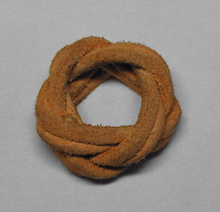
A scouting boondoggle
boondoggle (plural boondoggles)
- A braided ring to hold a neckerchief, particularly in scouting; a woggle.
- (US) A waste of time and/or money; a pointless activity.
- Opponents consider this another billion-dollar government boondoggle.
Synonyms
- (ring): woggle
Translations
woggle — see woggle
pointless activity
|
|
See also
- (government program): white elephant
Verb
boondoggle (third-person singular simple present boondoggles, present participle boondoggling, simple past and past participle boondoggled)
- (intransitive) To waste time on a pointless activity.
References
- ↑ Boondoggle, World Wide Words, Michael Quinion
- ↑ $3,187,000 relief is spent to teach jobless to play; $19,658,512 voted for April; 'Boon Doggles' Made, New York Times, April 4, 1935
This article is issued from
Wiktionary.
The text is licensed under Creative Commons - Attribution - Sharealike.
Additional terms may apply for the media files.