bison
English
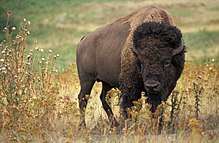
.jpg)
Etymology
Middle English bisontes (plural), from Old French bison, from Latin bisōn, bisōnt- (“wild ox”), from Proto-Germanic *wisundaz (“wild ox, aurochs”), from Proto-Indo-European *wisAn- (“aurochs, aurochs horn”), from Proto-Indo-European *weys- (“to flow, melt”). Akin to Old High German wisunt (“bison”), German Wisent (“bison”), Old English wesend, wusend (“bison, buffalo, wild ox”), Middle Dutch wēsent (“wild ox”).
Pronunciation
- IPA(key): /ˈbaɪ̯sən/
- Rhymes: -aɪsən
Noun
bison (plural bison or (chiefly dated) bisons)
- A wild ox, Bison bonasus.
- Synonyms: wisent, European bison
- A similar American animal, Bison bison else Bos americanus or Bisonte americano.
- Synonyms: American bison, buffalo (imprecise)
Translations
|
|
|
|
Further reading


Anagrams
French
Pronunciation
- IPA(key): /bi.zɔ̃/
un bison (file)
Noun
bison m (plural bisons)
Further reading
- “bison” in le Trésor de la langue française informatisé (The Digitized Treasury of the French Language).
Latin
Etymology
From Ancient Greek βίσων (bísōn), from Proto-Germanic *wisundaz (“wild ox, aurochs”)
Pronunciation
- (Classical) IPA(key): /ˈbi.soːn/, [ˈbɪ.soːn]
Noun
bisōn m (genitive bisōntis); third declension
Inflection
Third declension.
| Case | Singular | Plural |
|---|---|---|
| nominative | bisōn | bisōntēs |
| genitive | bisōntis | bisōntum |
| dative | bisōntī | bisōntibus |
| accusative | bisōntem | bisōntēs |
| ablative | bisōnte | bisōntibus |
| vocative | bisōn | bisōntēs |
References
- bison in Charlton T. Lewis and Charles Short (1879) A Latin Dictionary, Oxford: Clarendon Press
- bison in Gaffiot, Félix (1934) Dictionnaire Illustré Latin-Français, Hachette
Norman
Etymology
From Old French bison, from Latin bisōn, bisōnt- (“wild ox”), from Proto-Germanic *wisundaz (“wild ox, aurochs”).
Noun
bison f (plural bisons)