banyan
English
WOTD – 23 February 2009
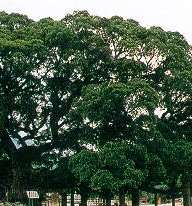
Ficus bengalensis
Alternative forms
Etymology
From Portuguese baniano, from Arabic بَنِيَان (baniyān), from Gujarati વાણિયો (vāṇiyo, “merchant”), from Sanskrit वाणिज (vāṇijá), from earlier वणिज् (vaṇíj, “merchant, trader”). The name appears to have been first bestowed popularly on a famous tree of this species growing near Bandar Abbas, under which the Bannians or Hindu traders settled at that port, had built a little pagoda.[1]
Pronunciation
Noun
banyan (plural banyans)
- An Indian trader, merchant, cashier, or money changer.
- A tropical Indian fig tree, Ficus benghalensis, that has many aerial roots.
- 1914, Teresa Frances & William Rose Benét, The East I Know, translation of original by Paul Claudel, page 33:
- We climb and then descend; we pass by the great banyan which, like Atlas, settling himself powerfully on his contorted haunches, seems awaiting with knee and shoulder the burden of the sky.
-
- A type of loose gown worn in India.
Synonyms
- (tropical Indian fig tree): banyan tree
Translations
Indian trader, merchant
|
tropical Indian fig tree
|
|
See also
-

-

References
- ↑ Yule, Henry, Sir. Hobson-Jobson (1903) A glossary of colloquial Anglo-Indian words and phrases, and of kindred terms, etymological, historical, geographical and discursive., London: J. Murray
This article is issued from
Wiktionary.
The text is licensed under Creative Commons - Attribution - Sharealike.
Additional terms may apply for the media files.