anemone
English
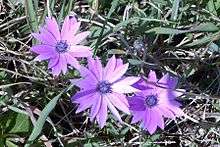
Anemone hortensis
Etymology
From Latin anemōnē, from Ancient Greek ἀνεμώνη (anemṓnē), from ἄνεμος (ánemos, “wind”) + feminine patronymic suffix -ώνη (-ṓnē, “daughter of the wind”).[1]
Or from Phoenician [script needed] (*naxmon), akin to Arabic شَقَائِق اَلنُّعْمَان (šaqāʾiq an-nuʿmān, “anemones”) and Hebrew (Isaiah Scroll) נִטְעֵי נַעֲמָנִים (nit'ei na'amanim, “plants of pleasantness”).[2][3][4]
Pronunciation
Almost invariably mispronounced as IPA(key): /əˈnɛn.ə.mi/
Noun
anemone (plural anemones)
- Any plant of the genus Anemone, of the Ranunculaceae (or buttercup) family, such as the windflower.
- A sea anemone.
Derived terms
Translations
any plant of genus anemone
|
|
sea anemone — see sea anemone
References
- ↑ "anemone". Oxford English Dictionary. Oxford University Press. 2nd ed. 1989.
- ↑ Edward Yechezkel Kutscher, The Language and Linguistic Background of the Isiah Scroll (Leiden, Netherlands: Brill, 1974), 380; first published in Hebrew, in Jerusalem, 1959.
- ↑ Babcock, Philip, ed., Webster's Third New International Dictionary of the English Language, Unabridged, s.v. "anemone" (Springfield, Mass.: Merriam-Webser, 1993).
- ↑ C.T. Onions, The Oxford Dictionary of English Etymology, s.v. "anemone" (Oxford: Oxford University Press, 1967).
Italian
Noun
anemone m (plural anemoni)
Related terms
- anemone di mare
See also
Latin
anemōnae (windflowers)
Etymology
From Ancient Greek ἀνεμώνη (anemṓnē). Pliny says it was so called because the flowers opened only when the wind blew.
Pronunciation
- (Classical) IPA(key): /a.neˈmoː.neː/, [a.nɛˈmoː.neː]
Noun
anemōnē f (genitive anemōnēs); first declension
Inflection
First declension, Greek type.
| Case | Singular | Plural |
|---|---|---|
| nominative | anemōnē | anemōnae |
| genitive | anemōnēs | anemōnārum |
| dative | anemōnae | anemōnīs |
| accusative | anemōnēn | anemōnās |
| ablative | anemōnē | anemōnīs |
| vocative | anemōnē | anemōnae |
Descendants
References
- anemone in Charlton T. Lewis and Charles Short (1879) A Latin Dictionary, Oxford: Clarendon Press
- anemone in Gaffiot, Félix (1934) Dictionnaire Illustré Latin-Français, Hachette
- anemone in Harry Thurston Peck, editor (1898) Harper's Dictionary of Classical Antiquities, New York: Harper & Brothers
This article is issued from
Wiktionary.
The text is licensed under Creative Commons - Attribution - Sharealike.
Additional terms may apply for the media files.